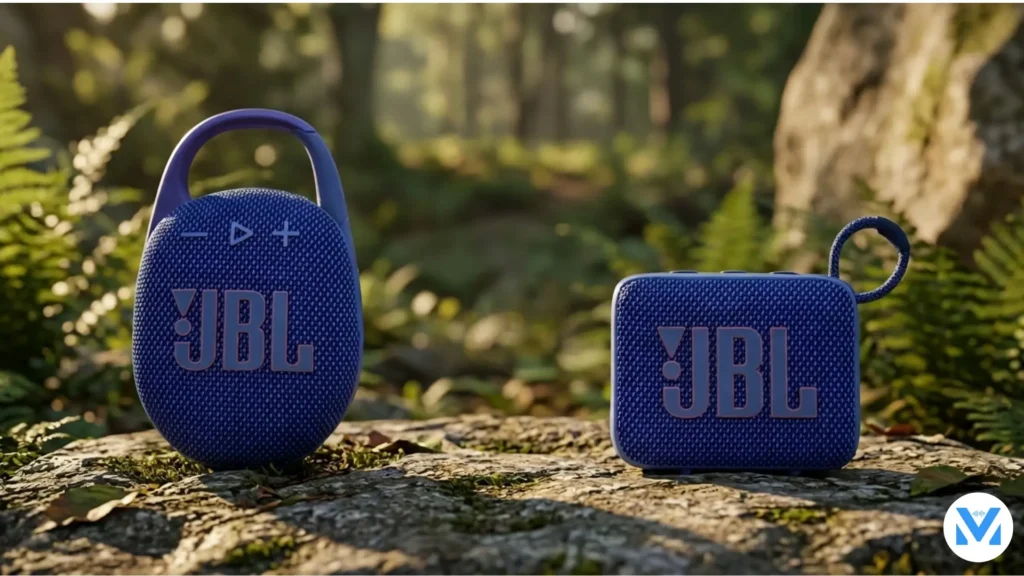
JBL makes a lot of compact speakers, and two of the most popular ones right now are the Go 4 and the Clip 5. They sit close in price, they are both small enough to throw in a bag, and they both carry JBL’s signature look. But comparing the two and the differences become pretty clear. We went through the specs, ran some listening tests, and put together everything you need to make the right call.
Table of Contents
Design and Portability
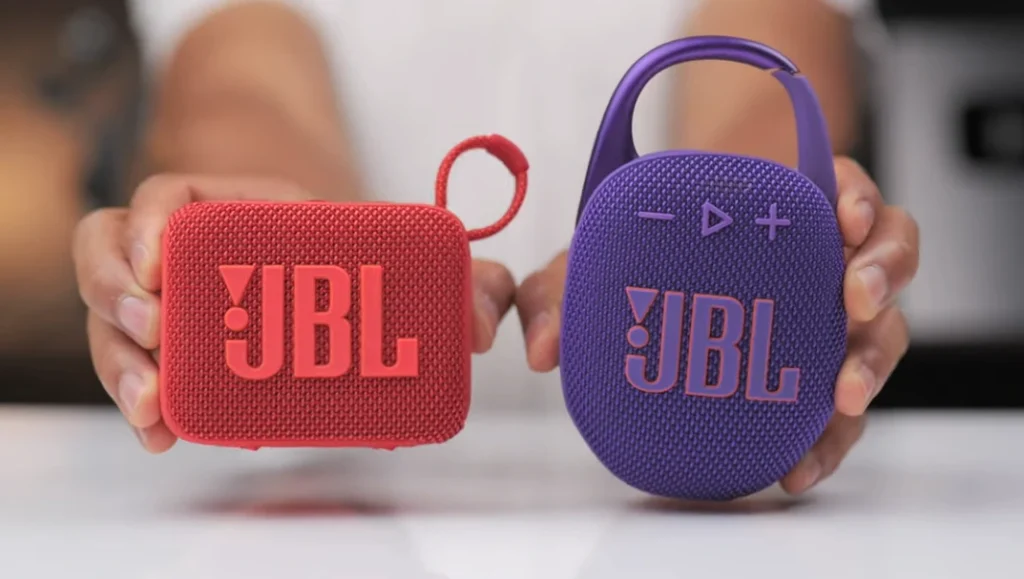
Both speakers share the same general aesthetic fabric grille, rubber rear panel, vibrant colorways, and a build quality that feels solid for the price. First impressions on either one are good.
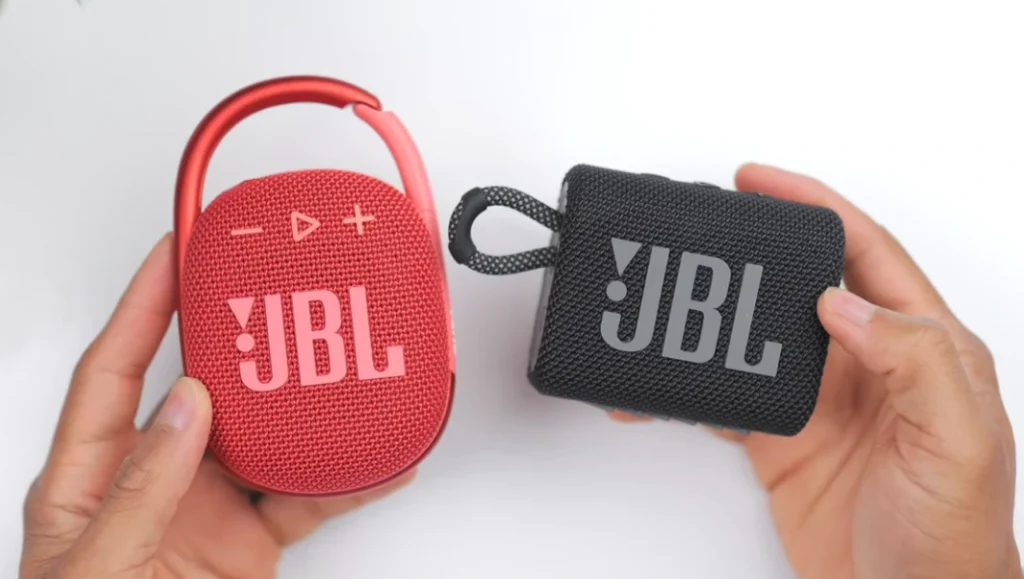
Where they split is in attachment. The Clip 5 has a built-in metal carabiner with a silicone-lined interior that clips directly onto bag straps, belt loops, and outdoor gear. It is purpose-built for on-the-go use and works exactly as advertised. The Go 4 uses a fabric loop instead. It gets the job done, but if you want to clip it onto something, you are probably buying a separate carabiner.
Weight is another clear difference. The Go 4 comes in at 195 grams. The Clip 5 is 289 grams nearly 100 grams heavier, largely because of the carabiner and the larger chassis. The Go 4 also has a useful trick up its sleeve: it can stand upright on its own, which gives you more flexibility for placement on a desk or surface.
If you want the lightest, most pocketable option, the Go 4 wins. If you want something that clips properly onto your gear without any extra accessories, the Clip 5 is the better choice straight out of the box.


Sound Quality
This is where the two speakers separate themselves most clearly, and it is not particularly close.
The Clip 5 runs at 7 watts. The Go 4 runs at 4.2 watts. That power gap is audible. At maximum volume, the Clip 5 hit 99.5 dB in testing versus the Go 4’s 97.1 dB. On paper that does not sound like much, but in practice the Clip 5 sounds noticeably fuller, richer, and more commanding — especially outdoors where background noise starts to compete with your audio.
Frequency response tells a similar story. The Go 4 starts at 110Hz. The Clip 5 extends down to 90Hz. That extra 20Hz of low-end reach makes a real difference for bass presence and fullness at this size class.
Then there is the JBL Portable app. The Go 4 has no app support at all. Whatever sound profile it ships with is the sound profile you get, permanently. The Clip 5 connects to the JBL Portable app and gives you multiple EQ presets plus a fully customisable equaliser to adjust highs, mids, and lows to your liking. Sound quality goes to the Clip 5, clearly.
Battery Life
The Go 4 delivers up to 7 hours of playback on a single charge. That is workable for a short day out or a commute, but it starts to feel limiting if you are going somewhere for the whole day without a charger nearby.
The Clip 5 pushes that to 12 hours standard, and then adds Playtime Boost mode on top, which can extend playback to a potential total of around 14 hours by optimising audio output. It does trim some low-end frequencies in Boost mode, so there is a small sound quality trade-off, but the endurance advantage is significant.
Charging time is identical at approximately 3 hours for both via USB-C, so there is nothing to separate them there.
For most casual daily use, 7 hours is fine. For a full day out, a camping trip, or any scenario where charging is not easy, the Clip 5 is the better option by a clear margin.
Connectivity
Both speakers use Bluetooth 5.3, so pairing is fast and the connection is stable on both iOS and Android. No issues with either in real-world use.
The bigger story is what the Clip 5 can do that the Go 4 cannot. The Clip 5 supports Auracast, which means you can pair two Clip 5 units together for true stereo sound or connect multiple compatible JBL speakers for a wider sound field. It also supports multi-point connection, letting you stay paired to two devices at the same time.
The Go 4 connects to one device and plays audio. That is it. No multi-speaker pairing, no stereo mode, no ecosystem integration.
If you own other JBL speakers or think you might buy another one down the line, the Clip 5 is the only one of the two that makes sense.
Read More: JBL Go 3 vs JBL Go 4: Same Size, Bigger Leap
Waterproofing and Floatability
Both speakers carry an IP67 rating, meaning both are fully dustproof and can handle submersion in up to one metre of water for 30 minutes. Both kept playing audio during submersion testing, so the waterproofing works as advertised on each unit.
The interesting difference here is floatability. The Go 4, thanks to its lighter weight and smaller build, floats on the water’s surface. If it slips into a pool or a lake, you can fish it back out easily. The Clip 5 sinks. The metal carabiner and larger mass mean it goes straight to the bottom if it hits the water.
Both are waterproof. But if you are using your speaker near water and a drop is a realistic possibility, the Go 4 is significantly less risky.
Specs at a Glance
| Specification | JBL Go 4 | JBL Clip 5 |
| Output Power | 4.2W | 7W |
| App / EQ Support | None | JBL Portable app, custom EQ |
| Bluetooth Version | 5.3 | 5.3 |
| Multi-Speaker / Auracast | No | Yes |
| Stereo Pairing | No | Yes (two Clip 5 units) |
| Battery Life (standard) | 7 hours | 12 hours |
| Playtime Boost | No | Yes (up to ~14 hours) |
| Charge Time | 3 hours | 3 hours |
| IP Rating | IP67 | IP67 |
| Floats on Water | Yes | No |
| Weight | 195g / 0.46 lbs | 289g / 0.69 lbs |
| Dimensions | 3.7 x 3.0 x 1.7 in | Larger form factor |
Sustainability
JBL built the Clip 5 with post-consumer recycled plastic and a recycled fabric speaker grille. The packaging uses FSC-certified paper printed with soy-based ink. The Go 4 has no equivalent sustainability commitments documented. For anyone factoring environmental impact into their buying decision, the Clip 5 is the only credible option here.
Read More: JBL Clip 4 vs JBL Clip 5: Is the Upgrade Worth It?
Final Thoughts
The Go 4 and Clip 5 serve similar purposes but at noticeably different performance levels. Here is the short version.
Choose the Go 4 if you want the lightest, most pocketable option, you are working with a tighter budget, or you plan to use it near water where floatability matters.
Choose the Clip 5 if you want louder and fuller sound, longer battery life, a built-in carabiner that actually works, app-based EQ control, and multi-speaker support. It costs around $40 more, but the gap in what you get is larger than the gap in what you pay.
For most buyers, the Clip 5 is the better investment. The Go 4 is not a bad speaker, it just does less, and the price difference does not fully account for how much more capable the Clip 5 is.
Read More: Tribit Stormbox Blast 2 Review