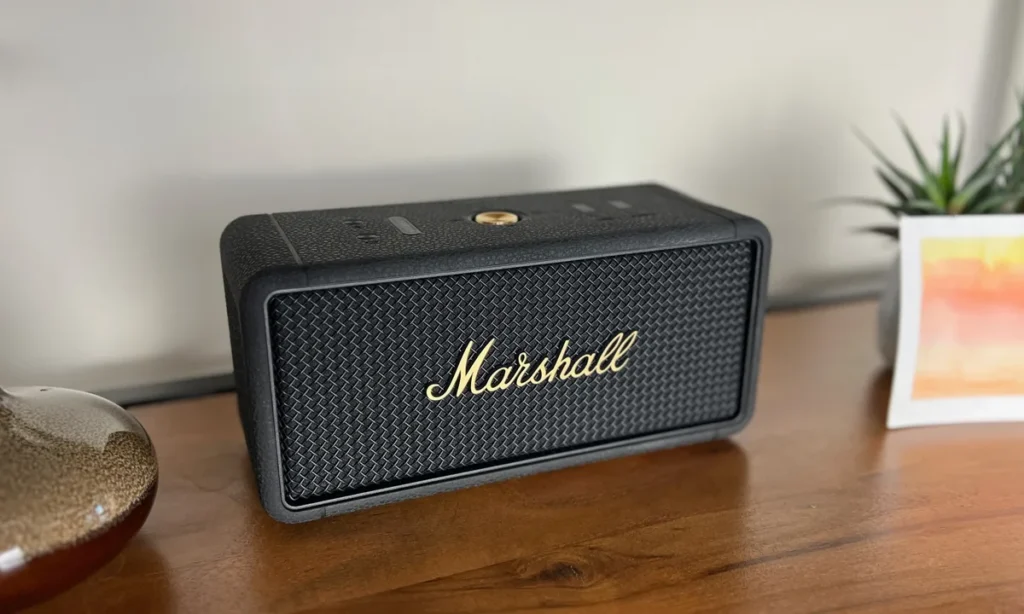
Marshall are back again with another Bluetooth portable speaker in their signature style. The Marshall Middleton joins the brand’s range of portable and home speakers, but with its more heavy duty design, could this be a good solution for both home and away? And is it worth its $255 price tag? Let’s find out.
Where Does It Sit?
Marshall have a range of portable speakers and a range of home speakers in their lineup, and with the price and weight of the Middleton, this speaker sits slap bang in the middle. The initial thought here is that you’d get more sound for your money going for a speaker in the home range, but you’d of course be missing out on that portability. For the portable speakers, you’re losing out a little in the sound department in place of additional features. So this speaker should offer the best of both, or it could miss the mark entirely.

Design
Marshall style is iconic, so it only feels right to kick things off here. The Middleton fits seamlessly into the range and is essentially the bigger brother to the fan favorite Emberton II. You get the traditional brass colored scripted logo, a black grille, and some nicely detailed black rubber casing, making for an overall design that’s easy to be a huge fan of. It’s currently only launched in this one colorway, but as with most other Marshall speakers, a few variations will likely follow.
Once out of the box, it’s clear this is a weighty little thing, probably down to the battery, and it’s definitely not a speaker you can chuck about. It’s considerably bigger than the Emberton II too, and nearly three times heavier. It weighs in at 1.8 kilos, roughly the weight of two liters of water for context. So although it’s classed as portable, it’s the type of speaker you’ll notice carrying in your rucksack for too long.
It also comes with a detachable carry handle, something that felt missing from the Emberton. It’s a simple loop with a little elasticity, and given the extra weight, it’s genuinely useful. The loop feels premium and durable too, with no worries about it breaking or tearing.
The Middleton carries an IP67 rating, meaning it’s fully submersible in up to one meter of water for 30 minutes, and it’s completely dust proof. This isn’t a speaker built for dual orientation, so you can’t stand it up on its side, but with drivers on the front, back, and sides, it offers proper multi directional sound.
Controls and Connectivity
On top you’ll find lovely rubber detailing and handy controls that look the part too. The brass center dial handles volume, play, pause, and skip, and there’s a Bluetooth pairing button alongside an LED strip that shows battery percentage and volume level while you’re adjusting it, a small feature that’s genuinely well rated. What really sets this apart from the average portable speaker are the adjustable bass and treble controls, sticking to that classic Marshall heritage.
The Marshall Bluetooth app gives you more control over the speaker too. It’s a pretty basic but nicely designed interface with simple playback controls and customizable EQ settings, letting you adjust the audio performance to suit your personal style. You can also use the app to set up Marshall Stack Mode, essentially Marshall’s version of speaker grouping, where you can group multiple Stack enabled Marshall speakers together to boost the sound.
It’s even possible to group a Middleton and an Emberton together for extra volume, and the same works with the Willen. You can also bypass the app entirely and set up Stack Mode manually, by pressing the Bluetooth button three times on the main speaker and twice on the speaker you want to pair with it. Unfortunately, putting two Middletons into Stack Mode doesn’t create a true stereo pair, but two together for larger gatherings would still be seriously loud.
When it comes to connectivity, things are pretty simple, with Bluetooth 5.1 onboard. That’s fairly standard, and it means you can be set up and listening in under two minutes out of the box. As a multi point connection speaker, you can also connect two devices at once, handy if you’ve got two people fighting over the playlist, or you just want to switch between a laptop and a phone.
There’s also an aux line in on the rear if you’d rather go wired, say from a turntable. There’s no Spotify Connect or voice control here, which would have been a nice touch, but Bluetooth does the job well for this type of speaker, and connectivity issues were a non issue throughout testing.
Range Test
Marshall states a Bluetooth range of around 10 meters, but real world testing told a different story. Walking away from the speaker with a connected phone, the connection stayed completely solid past 10 meters, then 20, then 30, and kept going strong through 80 and 90 meters. By the time testing reached around 100 meters, the connection was still completely uninterrupted.
For parties or gatherings, there’s really no need to worry about this speaker cutting out. It’s also worth noting that since there’s no built in microphone, the Middleton can’t be used as a speakerphone for calls.
Battery Life and Powerbank Test
Battery life is a huge factor for portability, and the Middleton offers 20 hours of playback with a four and a half hour full recharge time. There’s also a Quick Charge feature, where a short 20 minute charge gives an extra two hours of play time. That’s a fairly solid battery life overall, though it is 10 hours less than the Emberton II, which feels a little disappointing given the price.
One genuinely useful feature is that the Middleton can double as a power bank for your phone, handy if you’re out and about and your battery is running low, though it will eat into the speaker’s own battery life.
In testing, charging a phone from 50 percent for an hour and 20 minutes brought it up to 80 percent, which isn’t bad, but the real catch was that the Middleton’s own battery dropped from 80 percent to 40 percent in that same window, without even playing any music. It’s a handy feature to have in an emergency, but it’s not one to rely on if you also want the speaker to keep playing.
Sound Performance
Internally, Marshall have really beefed this one up compared to the Emberton II. The Middleton makes full use of Marshall’s true stereophonic technology, delivering 360 degree multi directional sound wherever you place it. Unlike a lot of traditional front facing speakers, the Middleton can be placed anywhere and still separate out the spatial content of a stereo recording so it can be enjoyed from every angle.
In testing, the Middleton proved to be a bit of a beast. It immediately brings strong volume, a wide sound stage, and bass you can genuinely feel, making it a great option for outdoor spaces or parties. Instrument separation is impressive, and the vocals and detail are enjoyable too.
It’s not the most detailed sounding speaker out there, but that’s not really the point of a portable speaker like this. Overall, it’s lively, enjoyable listening, and the multi directional audio adds a level of immersion that isn’t always expected from a portable unit. As a portable speaker, expect great volume out and about, but the real benefits of that solid audio performance shine once you bring it home.
Middleton vs Emberton II
Placing the two side by side makes the comparisons easy to draw. On pure performance, the Middleton wins hands down, and it should, considering the price jump. Listening to them side by side, switching to the Emberton feels like a real loss in bass. The Middleton also offers a little more control, since the Emberton only allows customizable EQ presets through the app, rather than full manual adjustment.
There’s a considerable price gap between the two, so if the same signature Marshall sound on a smaller, less bassy scale works for you, the Emberton II is probably the better choice for a genuine out and out portable speaker.
But for the performance and spec gained with the Middleton, it earns its place firmly in the premium portability category, arguably justifying being priced just over a hundred pounds more, especially when you factor in that it can double as a capable home speaker too. As always, this comes down to personal preference and how you actually plan to use it.
Middleton vs JBL Xtreme 3
The JBL Xtreme 3 has pretty much dominated this price point and size category for a while now. From an initial comparison, the two offer slightly different performances that will appeal to different audiences. The Xtreme 3 seems to sound slightly louder, while the Middleton offers a more rounded performance with a weightier low end. More testing would be needed for a full verdict on that comparison.

Durability
It’s one thing for a speaker to look durable, but the real question is how it holds up when pushed to the limit. The Middleton was put through a series of drop tests on different surfaces, including a rough toss into some mud. Despite the punishment, and a fair amount of dirt picked up along the way, the speaker came through the testing in genuinely impressive shape. For the average user, this level of abuse is unlikely, but it’s reassuring to know the Middleton can survive it if it happens.
The speaker was also submerged in water and left for half an hour as part of the indoor testing, further backing up that IP67 rating and giving real confidence in its durability credentials.
Who Is It For?
The price is the biggest sticking point here. You can get a pretty decent portable speaker for half of what the Middleton costs, so the extra spend needs to make sense for your use case. If you’re after an out and out lightweight portable speaker that you can chuck in a bag for the occasional weekend trip or holiday, the Middleton probably isn’t the right call. The weight and size aren’t the most convenient for that scenario, and something like the Emberton II, the Bose SoundLink Flex, or the JBL Flip 6 would serve you better.
This is more of a heavy duty portable speaker, one you’d want to make use of around the home as well as the odd trip out and about, and that dual use case is really what helps justify the price point. It doesn’t feel like the type of speaker that sits in a drawer between weekend trips and holidays. The design plays a part too, for anyone with a brand affinity for Marshall or who simply likes the aesthetic, this is a genuinely nice addition to a living room.
It’s also worth factoring in the Marshall home range. The Acton III sits £10 cheaper and is, spec for spec, a more powerful speaker, so with the Middleton you are paying a premium for portability. Ultimately, the real question is what your non negotiables are, and how far you’re willing to go to have a slice of that signature Marshall sound in your life.
Final Verdict
The Marshall Middleton is a genuinely impressive speaker, but one that needs to be bought with the right use case in mind. It bridges the gap between Marshall’s portable and home ranges reasonably well, offering a big step up in bass and overall sound over the Emberton II, along with useful extras like the carry handle, power bank function, and full EQ control. Where it falls short is in outright portability, with its weight and size making it less suited to being thrown in a bag for every trip.
For anyone who wants a speaker that lives at home most of the time but can still head out for parties, gatherings, or the odd weekend away, the Middleton makes a strong case for itself despite the £270 price tag. If lightweight, grab and go portability is the priority, the Emberton II or a rival like the JBL Flip 6 will likely serve you better.