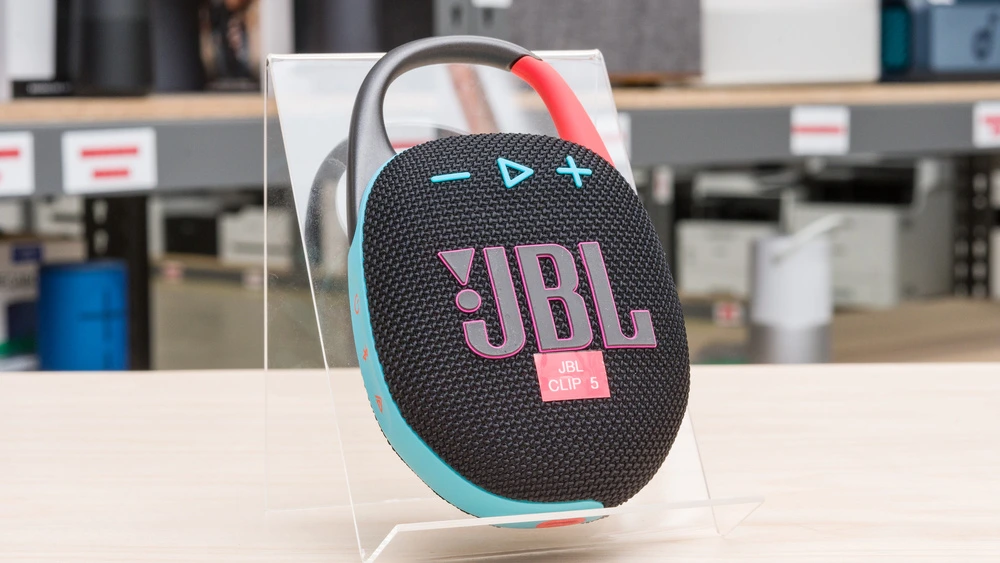
JBL’s Clip series has long set the standard for ultra-portable Bluetooth speakers – compact enough to go anywhere, durable enough to take the punishment. With the Clip 5 now on shelves alongside the still-popular Clip 4, buyers face a genuine choice. We compared every meaningful spec, from audio output and battery endurance to connectivity and build quality, to give you a clear, honest verdict.
Table of Contents
Design & Portability
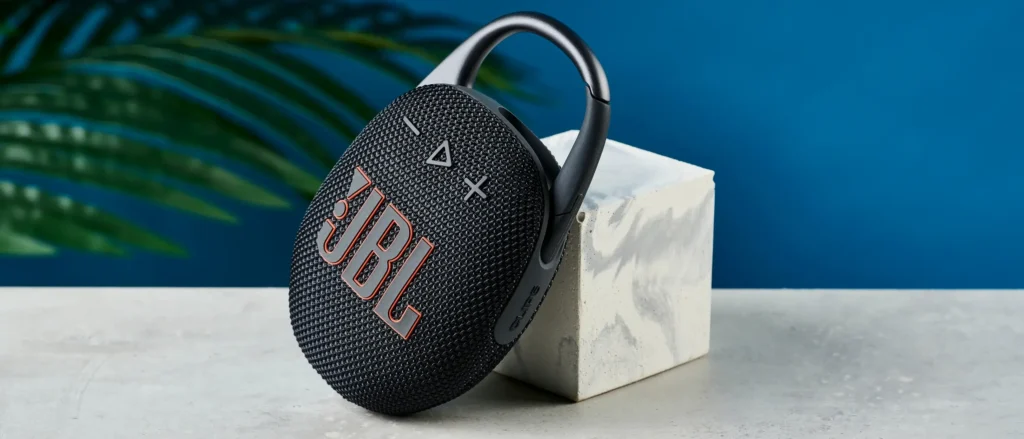
At first glance, you’d be forgiven for mistaking one for the other. Both the Clip 4 and Clip 5 share nearly identical dimensions 3.4″ × 5.3″ × 1.8″ and the same general oval shape that fits easily in the palm of your hand. JBL hasn’t reinvented the form factor, and that’s fine, because the original design still works brilliantly.
The meaningful difference is in the carabiner. The Clip 5 ships with a redesigned, wider integrated carabiner that opens further than the Clip 4’s, giving you more attachment options, belt loops, thicker bag straps, and hiking gear that the Clip 4 would have struggled to clip onto. The Clip 5 also adds thicker silicone padding on the back, meaning it can lay flat on a surface without rocking. The Clip 4 lacks both of these refinements.
The Clip 5 is slightly heavier at 0.628 lbs versus the Clip 4’s 0.53 lbs. It’s not a meaningful difference in hand, but it’s worth noting for those counting every ounce in a pack. Both speakers come in a range of vibrant colorways inspired by street fashion trends, so personal style is equally served. This round is a genuine tie the Clip 5 edges ahead on carabiner utility, while the Clip 4’s lighter build has its own appeal.


Sound Quality
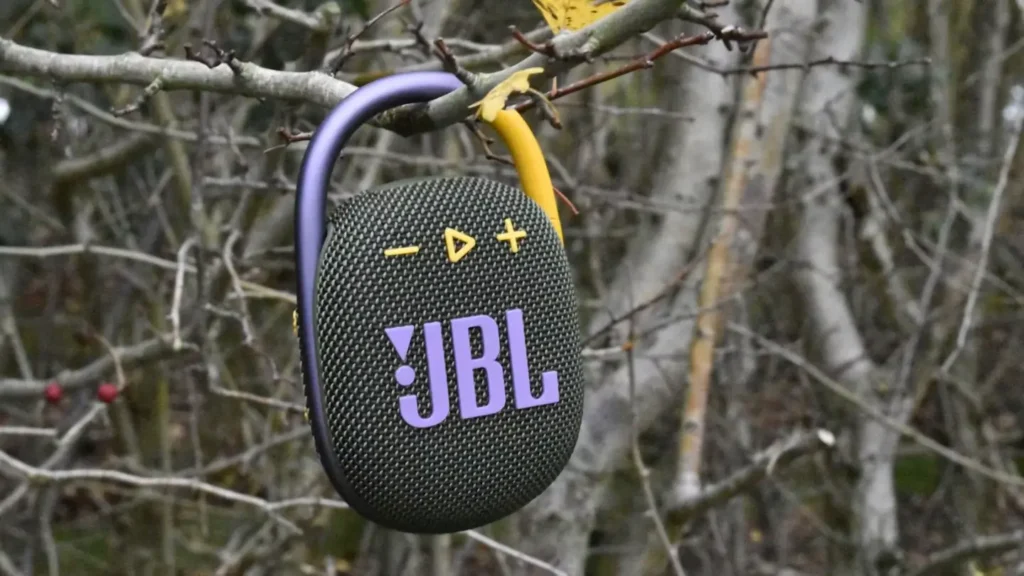
This is where the Clip 5 pulls away decisively. A 40% jump in output power from 5W on the Clip 4 to 7W on the Clip 5 is not a marketing number. You can hear it. The Clip 5 is noticeably louder and produces more convincing bass, aided by a passive radiator that the Clip 4 lacks. The Clip 4 delivers “surprisingly rich” audio for its size, but the Clip 5 goes further, delivering sound that can genuinely fill a small outdoor space.
The Clip 5 also extends slightly lower in frequency response down to 95Hz versus the Clip 4’s 100Hz, a modest but real improvement in low-end presence. For a speaker this small, every hertz matters.
Then there’s the JBL Portable app. The Clip 4 has none what you hear out of the box is all you get. The Clip 5, by contrast, connects to the app and offers a fully customizable 5-band EQ alongside preset modes. If you want to punch up the bass for a beach playlist or crisp up the highs for acoustic music, the Clip 5 gives you the tools. The Clip 4 simply doesn’t. Sound quality goes firmly to the Clip 5.
Read More: JBL Xtreme 4 Review & Testing
Battery Life
The Clip 4 offers a solid 10 hours of playtime on a single charge, which is more than enough for a day out. The Clip 5 raises that to 12 hours a 20% improvement and then introduces Playtime Boost mode, which can squeeze out an additional 3 hours by optimizing the audio output. That’s up to 15 hours total, though Playtime Boost does trim low-end frequencies to conserve power.
Both speakers charge in approximately 3 hours via USB-C, which is identical. For most daily users, 10 hours is plenty. But if you’re going on a weekend camping trip or a long hike where charging isn’t an option, the Clip 5’s extended endurance is a genuine advantage. Battery life goes to the Clip 5.
Connectivity
Both speakers use Bluetooth as their sole wireless connection method no aux input, no NFC. But the generation of Bluetooth they use is different. The Clip 4 runs on Bluetooth 5.1; the Clip 5 upgrades to Bluetooth 5.3, which brings improved connection stability and slightly better power efficiency. In practice, both pair quickly and reliably, but the Clip 5 is the more future-proof choice.
The bigger connectivity story is Auracast. The Clip 5 supports JBL’s Auracast multi-speaker technology, allowing you to connect it wirelessly to multiple compatible JBL speakers for a broader, louder sound field. It can also be stereo-paired with a second Clip 5 for true stereo sound. The Clip 4 supports neither of these features. If you own or plan to own multiple JBL speakers, the Clip 5’s ecosystem advantage is hard to ignore.
Durability
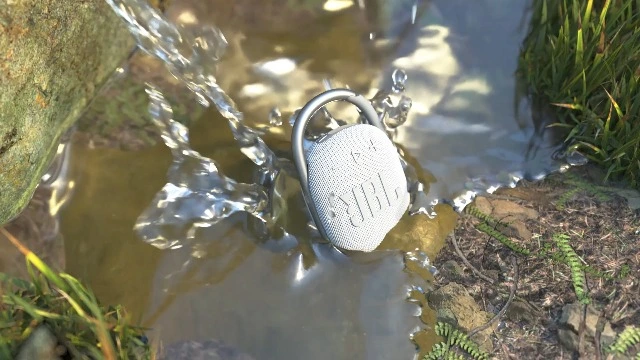
Both speakers carry an IP67 rating, which is the same certification level. That means both are fully dustproof and can be submerged in up to one meter of water for up to 30 minutes. Whether you’re caught in the rain, using it poolside, or taking it into the shower, both the Clip 4 and Clip 5 handle it without issue. There is no difference here. Durability is a tie.

Sustainability
JBL made a point of building eco-conscious materials into the Clip 5. The speaker uses post-consumer recycled plastic in its construction, and the speaker grille fabric is also made from recycled materials. Packaging uses FSC-certified paper printed with soy-based ink. The Clip 4 has no equivalent sustainability commitments on record. For buyers who care about environmental impact, the Clip 5 makes the right noises.
Specs – JBL Clip 4 vs JBL Clip 5
| Spec | JBL Clip 4 | JBL Clip 5 |
| Output Power | 5W | 7W |
| Frequency Response | 100Hz – 20kHz | 95Hz – 20kHz |
| Battery Life | Up to 10 hours | Up to 12 hours (+3 hrs with Playtime Boost) |
| Charging Time | 3 hours | 3 hours |
| Bluetooth Version | 5.1 | 5.3 |
| Bluetooth Profile | A2DP 1.3, AVRCP 1.6 | A2DP 1.4, AVRCP 1.6 |
| IP Rating | IP67 | IP67 |
| Dimensions (W×H×D) | 86 × 135 × 46mm / 3.4″ × 5.3″ × 1.8″ | 86.3 × 134.5 × 46mm / 3.4″ × 5.3″ × 1.8″ |
| Weight | 0.239 kg / 0.53 lbs | 0.285 kg / 0.628 lbs |
| Driver | Single driver | Driver + passive radiator |
| App Support | No | Yes (JBL Portable App, 5-band EQ) |
| Multi-speaker | No | Stereo pair + Auracast |
| Carabiner | Integrated | Redesigned wider integrated |
| Sustainability | — | Recycled materials, FSC packaging |
| In the box | Speaker, USB-C cable, Quick-start guide, Warranty card, Safety sheet | Speaker, USB-C cable |
Final Thoughts
The JBL Clip 5 is the clear winner – with one caveat.
In almost every category that matters sound quality, battery life, connectivity, and sustainability the Clip 5 wins outright. The 7W output, 5-band EQ, Auracast support, and Playtime Boost make it a meaningfully better speaker, not just a marginal refresh. If you’re buying a Clip speaker today, buy the Clip 5. The only reason to consider the Clip 4 is price; if you can find it discounted, it remains a capable, proven performer for users who don’t need app control or multi-speaker pairing. But for anyone starting fresh, the Clip 5 is the one to get.
Read More: PreSonus Eris 3.5 vs Yamaha HS3 Comparison