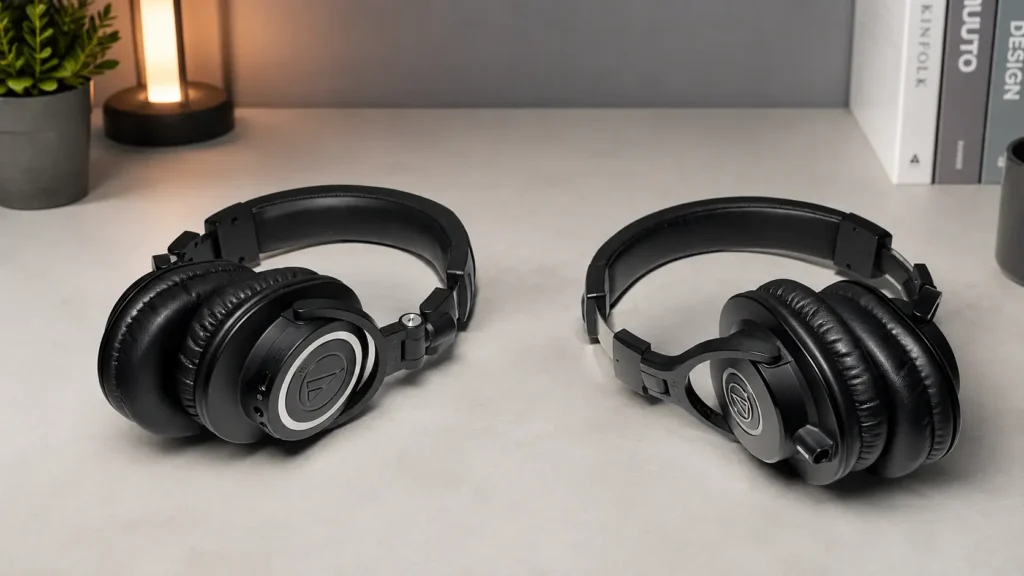
After years of relying on the ATH M40x as a trusted pair of isolation headphones for cello practice, editing videos, and travel, the time finally came to test them against their more famous sibling, the ATH M50x BT2. These are essentially the legendary M50x with capable Bluetooth componentry added for wireless use. The question worth answering: are the M50x really that much better than the M40x, or is the extra cost not justified?
Unboxing and Included Accessories
Audio Technica sets buyers up well right out of the box, and there are no major differences between the two models except for the cables included.
The M40x ships with a much longer twist and lock 2.5mm to 3.5mm cable, along with a 3.5mm to quarter-inch screw-on adapter, ideal for studio use. It also comes with a coiled cable for those who prefer that style.
The M50x BT2, on the other hand, includes a much shorter, thinner, and more flexible 3.5mm to L-shaped 3.5mm cable. This length is better suited for travel rather than studio work, so a separate 3.5mm cable would be needed for studio use.
One important note for anyone replacing the 3.5mm cable on the M50x: make sure the connector has a narrow base. It is not a proprietary connector, but a wide one simply will not fit into the M50x port.
Since the M50x BT2 supports Bluetooth, it also includes a short USB A to USB C cable for charging.

Build Quality
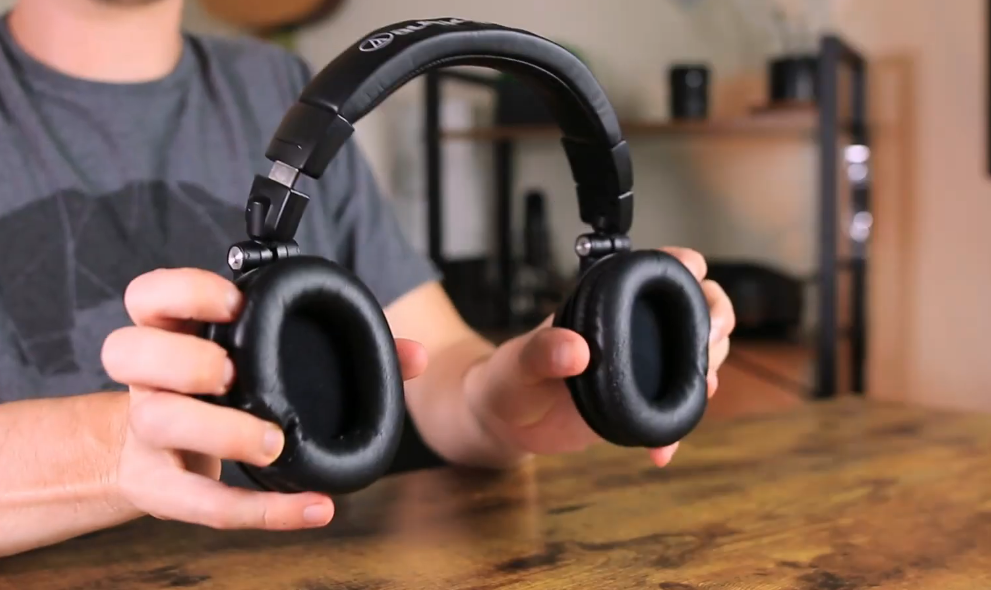
There are only minor aesthetic differences in build. The M50x cups can spin both outward and inward, while the M40x cups can only spin outward. Both models can be inverted and folded flat for travel.
The M50x also has slightly thicker padding on top, though it is only mildly noticeable. Additionally, the M50x uses 45mm drivers compared to the 40mm drivers in the M40x, which makes the M50x cups just a touch larger.
Comfort
The M50x BT2 cups are a bit heavier due to the added Bluetooth componentry, though this does not meaningfully affect comfort. Both headphones feel designed for larger heads. Wearing a cap requires maxing out the headband extension on the M40x, where it fits just barely, while the M50x leaves about four extra notches of room.
Despite similar cup sizes, the M50x felt noticeably more comfortable overall. They sit around the ears a bit better, and the pads feel more plush with extra give. The M40x pads, while looking the same, feel slightly stiffer in comparison.

Amplification
For a fair test, both headphones were run at the same volume using a THX AAA 789 amp, at roughly 11:30 AM on gain 1, and on an iPhone 13 Pro through a lightning dongle at around 9 to 10 out of 16.
Sound Comparison
This comparison focuses on wired mode only, since most people considering these headphones are likely looking for a reliable mixing headphone used over a wired connection.
Bass
The M40x has a noticeably more bloated mid-bass and upper bass presence. The M50x, thanks to its 45mm drivers, offers deeper sub bass extension. This becomes especially noticeable in electronic bass-heavy tracks. While both headphones hit hard, the M50x leans toward the sub bass region, while the M40x leans toward mid bass.
Neither headphone handles bass guitar particularly well; both add a bit too much bloat, making the bass guitar sound woollier than ideal. The M50x manages this slightly better due to less mid-bass emphasis.
The 100 to 400 Hz range is a weak spot for both headphones, often adding unwanted warmth to already emphasized tracks. The M50x shows more control here, avoiding the muddier presentation heard on the M40x. Kick drums come through thicker and tubbier on the M40x, while the M50x presents them leaner, punchier, and clearer.
Overall, the bass section clearly favors the M50x for its control and accuracy.
Mids
Female vocals sound more forward on the M50x, closer to neutral, though slightly less full than on the M40x. In tracks where vocals are meant to stand out and feel intimate, the M50x delivers that presence more effectively.
Instruments in the cello range sound fuller and more accurate on the M40x, though the M50x reveals a bit more detail, capturing subtle nuances like pluck and bow friction more clearly. Brass instruments are also brought forward more on the M50x, adding extra detail that sounds closer to real life compared to the M40x.
Overall, the M50x brings the mids forward in a way that feels more balanced with the bass and treble, resulting in a sound that feels both neutral and enjoyable.
Treble
The M50x has a slightly more forward treble response than the M40x, sounding airier with a touch more metallic character. Both headphones share some sharpness in the consonant region, so that trait is not exclusive to either model.
The M40x keeps airiness more distant and reserved, sometimes making subtle details like coin rubbing sounds in certain tracks easy to overlook. The M50x brings these details forward more consistently. Cymbals and hi-hats also sound closer to real life on the M50x, offering more definition and texture.
Soundstage and Imaging
As expected from closed-back headphones, neither model offers a particularly wide soundstage. The M40x has a slightly wider soundstage, though the difference is minor. Imaging shows a modest improvement on the M50x, making it a little easier to track sounds moving from left to right and front to back. Both headphones still perform well for their price range in this regard.
Final Thoughts
After spending real time with both headphones side by side, the conclusion is clear: the M50x BT2 is not inferior to the M40x, a belief that took far too long to correct. The M50x offers a more neutral tuning with better detail and imaging overall, plus the added benefit of Bluetooth connectivity when needed.
For anyone whose budget allows it, the M50x is the recommended choice over the M40x. That said, the M40x remains a fantastic pair of headphones in its own right, especially for those who prefer its particular signature, and it can often be found on sale for around 80 to 100 dollars.
Between the two, the plan going forward is to keep the M50x and part ways with the M40x after years of reliable use.
Read More: Tozo T10 Wireless Earbuds Unboxing & Review