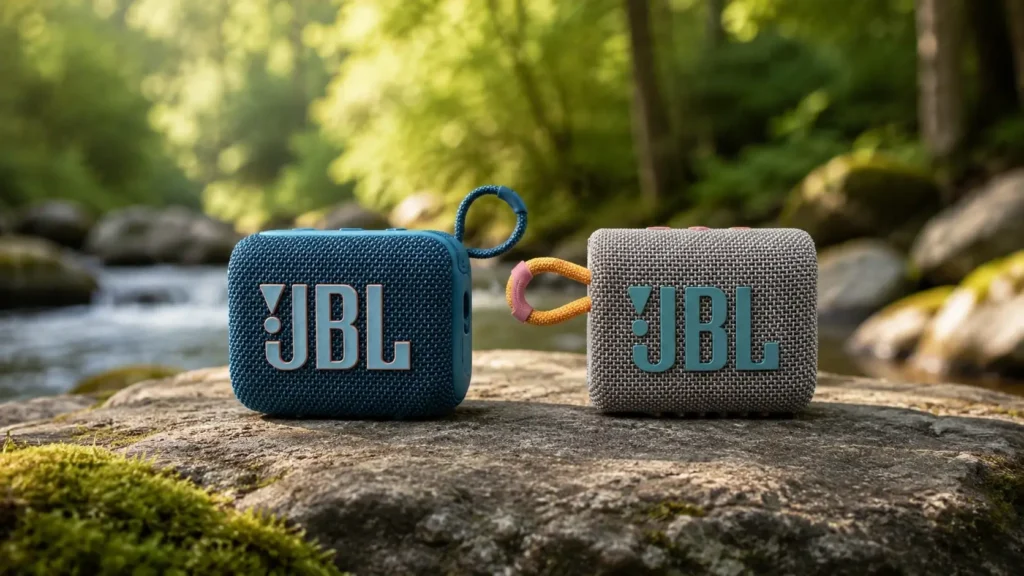
JBL’s Go series has long answered a single question with remarkable consistency: how much audio performance can you engineer into the smallest possible form factor? The Go 3 made a compelling case through personality-first design and crowd-pleasing aesthetics. The Go 4 inherits that identity while meaningfully upgrading every specification that drives a real purchase decision. We compared both speakers across six categories using only. Here is exactly where each one stands.
Table of Contents
Design and portability
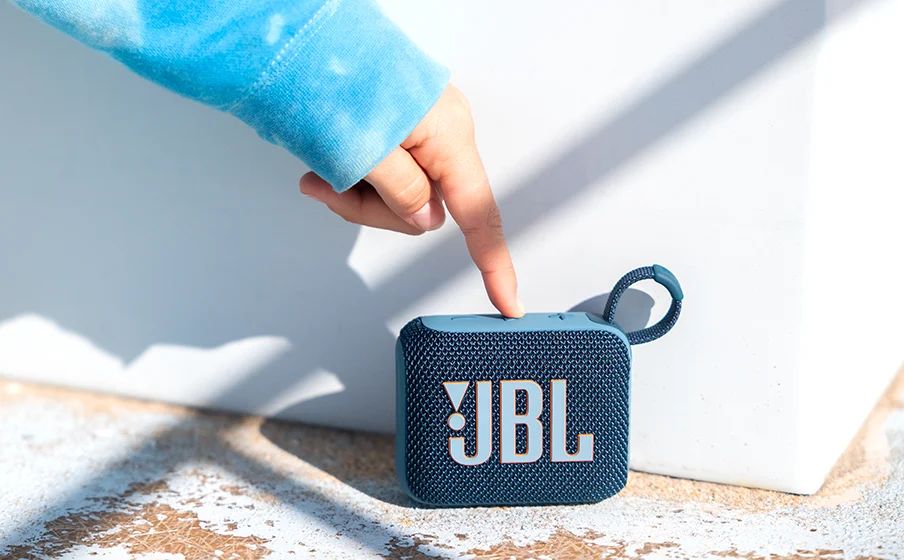
At first glance, the Go 4 appears to be a straightforward successor to the Go 3. Both share the same palm-sized silhouette and vibrant street-fashion colorways that have defined the Go lineup. However, the Go 4 is measurably larger in every dimension: 3.7 x 3.0 x 1.7 inches against the Go 3’s 3.4 x 2.7 x 1.6 inches. More significantly, the Go 4 weighs 0.69 lbs compared to the Go 3’s 0.46 lbs. That is a 50 percent increase in weight from a speaker that was already designed to disappear into your daily carry.
The Go 4 does introduce a redesigned integrated loop that opens wider and offers more versatile attachment options across bags, carabiners, and outdoor gear. It is a genuine quality-of-life improvement. Even so, it does not offset the weight and size advantage the Go 3 holds for users prioritizing true pocketability. If ultraportable convenience is the primary criterion, the Go 3 retains a meaningful edge in this category.

Sound quality
Both speakers operate at identical 4.2W output, so raw volume is comparable on paper. The substantive difference lies in frequency response. The Go 4 reaches down to 90Hz, whereas the Go 3 begins at 110Hz. That 20Hz extension is not a trivial specification gap at this size class – it represents a meaningful improvement in low-end presence and bass reproduction. JBL positions the Go 4 as delivering “punchier bass,” and the technical specifications fully support that claim.
Equally significant is the Go 4’s integration with the JBL Portable app. Users gain access to multiple EQ preset options alongside a fully customizable equalizer for adjusting highs, mids, and lows to personal preference. The Go 3 offers no such functionality. Its audio profile is fixed at the factory, with no mechanism for adjustment. For listeners who care about how their music is tuned, the Go 4’s flexibility is a decisive advantage. Sound quality goes to the Go 4 without reservation.
Battery life
The Go 3 delivers up to 5 hours of continuous playback on a full charge. That is a workable figure for short commutes or casual listening sessions, but it falls short for extended outdoor use. The Go 4 extends that ceiling to 7 hours and introduces Playtime Boost, an audio optimization mode that prolongs playback by an additional 2 hours for a potential total of 9 hours. The Go 3 has no equivalent feature and no path to extending its runtime.
One minor point in the Go 3’s favor: it charges in 2.5 hours versus 3 hours for the Go 4. In practice, this difference is unlikely to influence most buying decisions, but it is worth acknowledging. On the metric that matters most how long the speaker lasts between charges the Go 4 is the stronger performer by a significant margin.

Connectivity
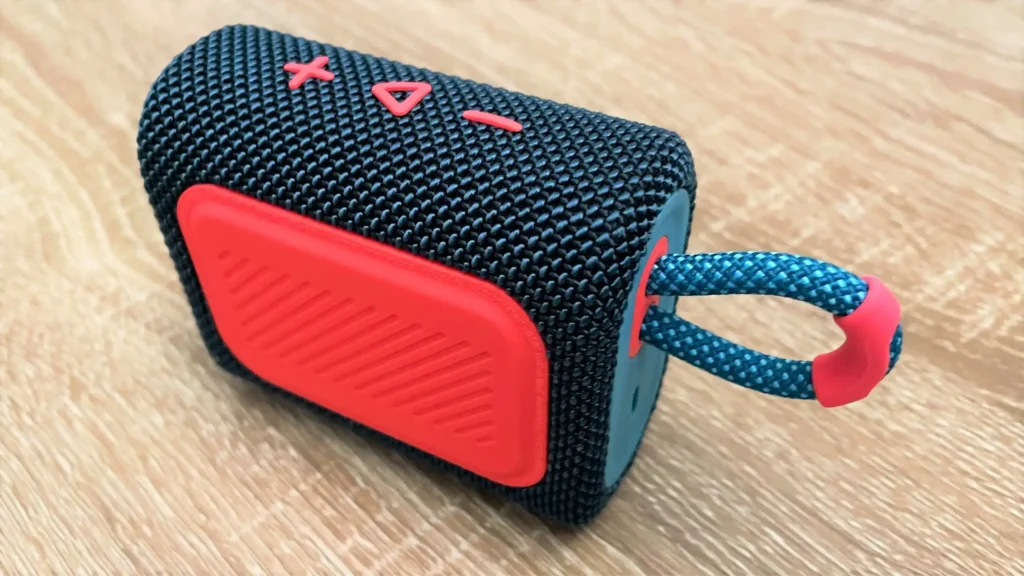
The Go 3 uses Bluetooth 5.1, which remains functional but represents an earlier standard. The Go 4 upgrades to Bluetooth 5.3, offering improved connection stability, lower latency, and better power efficiency. Both speakers pair quickly in real-world use, but the Go 4 is the more future-proof option as devices increasingly standardize around newer Bluetooth generations.
The more consequential connectivity distinction is Auracast. The Go 4 supports JBL’s Auracast multi-speaker technology, enabling users to pair two Go 4 units for true stereo playback or wirelessly connect multiple compatible JBL speakers for a larger, more immersive sound field. It also supports multi-point connection, allowing simultaneous pairing with two devices. The Go 3 supports none of these capabilities. It connects to one device and plays audio – nothing more. For anyone invested in the broader JBL ecosystem, the Go 4 is the only viable choice.
Durability
Both the Go 3 and Go 4 carry an IP67 certification, the same protection standard. Both are fully dustproof and can withstand submersion in up to one meter of water for a duration of 30 minutes. Rain, pool exposure, beach environments, and wet outdoor conditions present no operational risk to either speaker. There is no differentiation between the two products on this criterion. Durability is an equal draw.
Sustainability
JBL incorporated post-consumer recycled plastic into the Go 4’s construction and used recycled fabric for the speaker grille. Its packaging is FSC-certified paper printed with soy-based ink. The Go 3 has no comparable commitments on record. No recycled materials, no sustainability certifications, no ecological packaging initiatives are documented on its product page. For consumers who factor environmental responsibility into purchasing decisions, the Go 4 is the only credible option in this comparison.
Full Specification Comparison
| Specification | JBL Go 3 | JBL Go 4 |
| Output Power | 4.2W | 4.2W |
| Frequency Response | 110Hz and above | 90Hz and above |
| EQ / App Support | None | JBL Portable app with custom EQ |
| Bluetooth Version | 5.1 | 5.3 |
| Multi-Point Connection | No | Yes (two devices simultaneously) |
| Battery Life (standard) | 5 hours | 7 hours |
| Playtime Boost Mode | No | Yes (up to 9 hours total) |
| Charge Time | 2.5 hours | 3 hours |
| Waterproof Rating | IP67 | IP67 |
| Dustproof Rating | IP67 | IP67 |
| Dimensions | 3.4 x 2.7 x 1.6 inches | 3.7 x 3.0 x 1.7 inches |
| Weight | 0.46 lbs | 0.69 lbs |
Final Thoughts
The JBL Go 3 and Go 4 serve the same fundamental purpose but at meaningfully different capability levels. The Go 3 holds a genuine edge in one area only: it is lighter, more compact, and marginally faster to charge. For listeners who treat portability as the single non-negotiable criterion, that advantage is real.
Every other category belongs to the Go 4. Better bass extension, longer battery life, customisable EQ, Bluetooth 5.3, Auracast multi-speaker support, and sustainable construction collectively make it the more capable, more versatile, and more future-proof product. The weight increase is the only meaningful trade-off, and for most buyers it is an acceptable one.
If portability is your priority, the Go 3 still does its job. If performance is, the Go 4 is the only sensible choice.
Read More: Which Budget Microphone Should You Buy?