Let me be honest with you. The first time I saw the term “banana jack speaker cable,” I had no idea what it meant either. It sounds like something from a fruit store, not an audio shop.
But once you understand what it is, you will wonder how you ever connected speakers without one.
So let me break it all down for you in the simplest way possible.
Table of Contents
What Is a Banana Jack Speaker Cable?
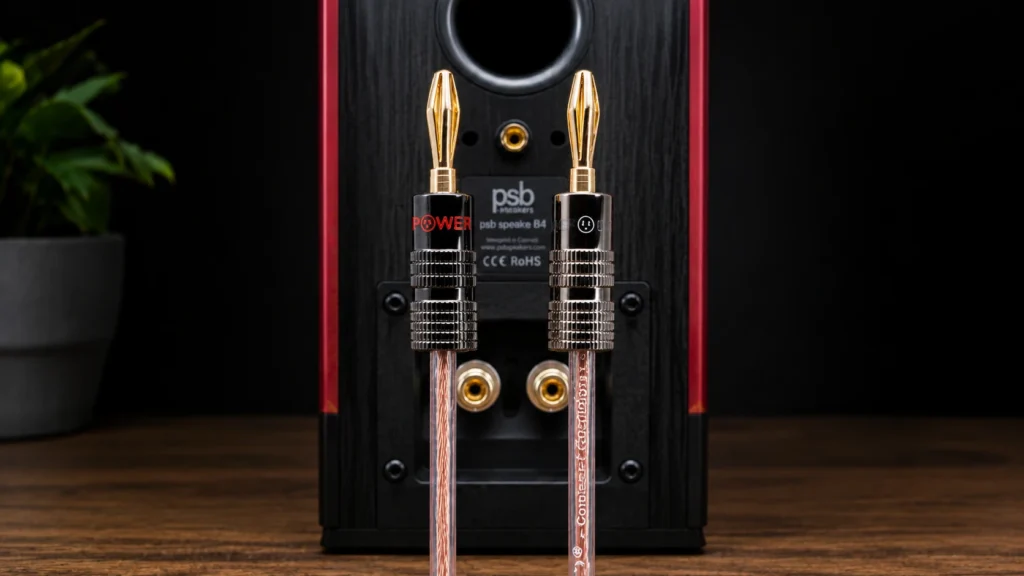
A banana jack speaker cable is a speaker wire that has special connectors attached at both ends. These connectors are called banana plugs on one end, and they fit into banana jacks (also called binding posts) on your speaker or amplifier.
Here is a simple breakdown:
- Banana Plug = the metal connector tip at the end of the cable. It is shaped slightly like a banana, which is exactly why it is called that. The metal leaves on the tip curve outward, and when you push it into a socket, it grips firmly.
- Banana Jack = the hole or port on your speaker or amplifier where the banana plug gets inserted.
- Speaker Cable = the wire that carries the audio signal from your amp to your speaker.
Put all three together and you get a banana jack speaker cable: a ready-to-use wire with banana plugs on both ends that makes connecting audio gear simple and quick.
Why Should You Use a Banana Jack Speaker Cable?
Good question. You might be thinking: “Can’t I just strip the wire and shove it into the terminal?”
Yes, you technically can. But here is why a banana jack speaker cable is a much better choice:
1. Easy to Connect and Disconnect: With bare wire, you have to unscrew the terminal, twist the wire, push it in, and screw it back. With a banana plug, you just push it in and it is done. Disconnecting is just as easy. This is a huge time saver if you ever need to move equipment around.
2. Better Sound Quality: Loose bare wires can cause poor contact, which leads to signal loss and even distortion. A good banana jack speaker cable keeps a firm, consistent connection, which means cleaner sound coming through your speakers.
3. Your Wires Stay Neat and Safe: Bare wire strands can fray over time. They can also accidentally touch each other, which can short-circuit your amplifier. Banana plugs protect the wire ends and keep everything tidy.
4. Color Coded for Easy Polarity Matching: Most banana jack speaker cables come with red and black connectors. Red is positive (+) and black is negative (-). This makes it very easy to match the right terminals on both ends without guessing.
How Does a Banana Jack Speaker Cable Work?
Nothing complicated here. Your amplifier takes an audio signal from whatever source you are using, a phone, a turntable, a streaming device, and it boosts that signal to power your speakers.
That boosted signal travels down the speaker cable and into your speaker, which converts it into sound.
Here is the signal path:
Amplifier/Receiver → Banana Jack Speaker Cable → Speaker
The banana plug and banana jack are just the connection points on each end of that cable. They are not doing anything magical. They are just making sure the signal passes through cleanly and consistently without any interruption.
Think of it like a water pipe. The pipe does not change the water. It just makes sure the water gets from point A to point B without leaking.
Types of Banana Jack Speaker Cables
When you start looking at banana jack speaker cables online, you will notice a lot of different specs and numbers. Here is what actually matters.
Wire Gauge (the AWG number)
AWG stands for American Wire Gauge. The confusing part is that a lower number means a thicker wire. So 12 AWG is thicker than 16 AWG.
Why does thickness matter? Thicker wire has less resistance. Less resistance means your speaker gets more of the power your amp is putting out, especially over longer cable runs.
For most home setups, 14 AWG hits the sweet spot. If your speaker is more than 5 meters away from your amp, go with 12 AWG to be safe.
Oxygen-Free Copper (OFC)
This is the material inside the wire. Oxygen-free copper is purer than regular copper, which means it conducts electricity better and resists corrosion longer. If you see OFC on the label, that is a good sign.
Watch out for cables labeled CCA (Copper Clad Aluminum). They look like copper cables but have aluminum inside. They are cheaper for a reason and not worth it.
Plug Type
This is where people often get confused. There are a few types of banana plugs:
Screw-lock plugs grip the wire with a small screw inside the plug body. Very secure, very reliable.
Locking or twist-lock plugs twist into the jack to lock in place. Great if your cables tend to get bumped or pulled.
Spring-type plugs are the most common cheap option. They work fine for casual use but can give a poor connection over time. Worth avoiding if you want a permanent setup.
Gold-plated tips are worth paying a little extra for. Gold does not corrode, so the contact stays clean for years.
Best Banana Jack Speaker Cables on Amazon
Now let’s get to the part you probably care most about: which one should you actually buy?
Here are our top picks for different needs and budgets.
1. GearIT 12AWG Speaker Cable Wire with Gold-Plated Banana Tip Plugs

Best Overall Pick
This is one of the most popular banana jack speaker cables on Amazon and for good reason. It uses 99.9% oxygen-free copper wire with gold-plated banana plugs, wrapped in a heavy-duty braided jacket. The build quality feels premium, and the connection is rock solid.
It comes in multiple lengths (6 ft, 10 ft, 15 ft, and more), so you can pick the right size for your setup.
Who it is for: Anyone setting up a home theater or stereo system who wants a reliable, great-looking cable without overspending.
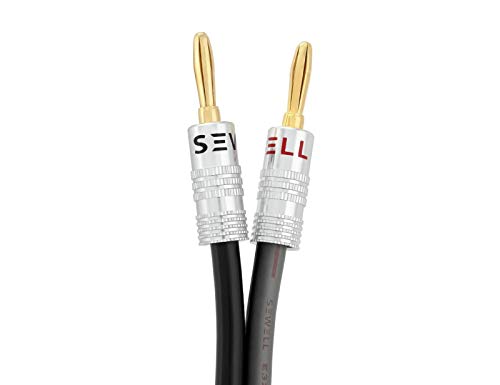
2. Silverback 12 AWG Speaker Wire with Banana Plugs by Sewell
Best for Audiophiles
The Silverback takes things up a notch. It uses 259 strands of copper (most 12 AWG cables use around 90 to 100 strands). More strands means less distortion, better bass, and cleaner highs. The banana plugs are 24K gold-plated with dual screws for an extra-secure connection.
If you have a high-end speaker setup and you want every detail in the music to come through clearly, this is worth the investment.
Who it is for: Audiophiles and serious home theater enthusiasts who care deeply about sound quality.
3. Amazon Basics Banana Plug 16AWG Speaker Cable Wire

Best Budget Pick
Not everyone wants to spend a lot, and that is totally fine. The Amazon Basics version does the job well for casual listeners and smaller setups. It is CL2 rated for in-wall use, uses oxygen-free copper, and comes with gold-plated 4mm banana-tip plugs.
It is a no-frills, honest cable that works reliably at a low price.
Who it is for: Beginners, renters, or anyone on a budget who just needs a clean and simple connection.
4. Micca 14 Gauge Pure Copper Speaker Cables with Banana Plugs

Best Mid-Range Option
Micca is a well-respected brand in the home audio world. Their 14 AWG banana plug speaker cables use pure copper with 245 strands and soldered banana plug construction, which is better than most cables at this price point. They also have a slim, clean design that looks great behind any setup.
Comes as a 2-pack, which makes it easy to wire stereo setups (left and right speakers) in one purchase.
Who it is for: Home audio fans who want a solid step up from basic cables without paying audiophile prices.
How to Use a Banana Jack Speaker Cable (Step by Step)
Even if you have never done this before, it is really simple. Here is how to connect it:
Step 1: Look at the back of your amplifier or receiver. You will see two binding posts (terminals) per channel, one red (positive) and one black (negative).
Step 2: Look at the back of your speaker. You will see the same thing: two binding posts, red and black.
Step 3: Take your banana jack speaker cable. Insert the red banana plug into the red jack on the amplifier.
Step 4: Insert the black banana plug into the black jack on the amplifier.
Step 5: Do the same on the speaker end. Red to red, black to black.
Step 6: Power on your system and play some audio to test it.
That is it. The whole process takes about two minutes.
What to Look for When Buying a Banana Jack Speaker Cable
Here is a quick checklist to keep in mind while shopping:
- Wire gauge: 12 AWG or 14 AWG is ideal for most home setups
- Conductor material: Look for 99.9% OFC (oxygen-free copper)
- Plug quality: Gold-plated banana plugs resist corrosion and give a cleaner signal
- Cable length: Measure the distance between your amp and speaker before buying. Buy slightly longer than you need.
- Locking mechanism: Screw-lock or twist-lock plugs are more secure than spring-type
- Shielding: A braided jacket gives the cable more durability and a cleaner look
Questions People Usually Ask
Is a banana jack speaker cable actually better than bare wire?
For most real-world setups, yes. Not because of some audiophile magic but because the connection is more reliable, more secure, and easier to maintain. The difference is especially noticeable with cheaper bare wire that frays or oxidizes over time.
Will any banana plug fit any banana jack?
In almost all cases, yes. The standard size is 4mm and the vast majority of speakers and amplifiers use this standard. If you have an older or unusual piece of equipment, double-check the specs first.
Does the cable itself affect sound quality?
Within reason, yes. A well-made cable with quality copper and good plugs will pass the signal more cleanly than a cheap one. But there is a point of diminishing returns. You do not need to spend $200 on a cable for a $300 speaker. The GearIT or Micca options in this list will perform excellently for any home audio setup.
What does the AWG number mean in simple terms?
Lower number equals thicker wire equals less resistance. 12 AWG is thicker than 16 AWG. Thicker is better for longer cable runs or higher-powered systems.
Wrapping Up
A banana jack speaker cable is one of those small upgrades that makes audio setup genuinely enjoyable instead of frustrating. Clean connections, no fraying wires, easy plug-in-and-play setup.
If you just need something solid for everyday use, the GearIT 12 AWG is the one to go with. If you want the best your money can buy without going into exotic audiophile territory, the Silverback by Sewell is worth every penny. And if budget is tight right now, the Amazon Basics option will still give you a proper clean connection.
Whichever one you pick, your speakers will thank you for it.
Read More: JBL Clip 4 vs JBL Clip 5