Real-time translation earbuds sound like something out of science fiction: put one in your ear, and suddenly you can talk to anyone on the planet. The Timekettle W4 is one of the most talked-about attempts to make that promise real, and this Timekettle W4 Review pulls together brand claims, hands-on impressions, and independent testing from multiple reviewers to give you the fullest picture available of what this device actually does, where it struggles, and whether it’s worth $349.
Unlike a single unboxing video, this Timekettle W4 Review is built from a wide cross-section of real-world use, including quiet one-on-one conversations, noisy airports and markets, offline mode with no signal, business meetings, and media translation. The goal is simple: give you an honest, detailed answer before you spend the money.
Table of Contents
Quick Verdict
The Timekettle W4 is a pair of semi-in-ear, bone-conduction earbuds built specifically for face-to-face translation across more than 40 languages, with online accuracy that ranges from genuinely impressive to noticeably inconsistent depending on the language pair, the mode, and how close you stay to your phone. It is not the flawless sci-fi translator shown in polished marketing demos, but it is a legitimate step forward from holding a phone screen between two people, and for the right buyer, in the right situation, it earns its place in a travel bag.
| Category | Rating |
| Translation accuracy (online, ideal conditions) | 4/5 |
| Translation accuracy (noisy or complex speech) | 2.5/5 |
| Comfort and fit | 3.5/5 |
| Build quality | 4/5 |
| App experience | 4/5 |
| Battery life | 3.5/5 |
| Value for money | 3/5 |
What Is the Timekettle W4?
The Timekettle W4 is a translation-focused pair of earbuds built around a split charging case: one earbud goes to you, the other goes to whoever you’re speaking with. Instead of holding a phone between two people or passing a device back and forth, each person wears an earbud and speaks normally while the Timekettle app on a connected smartphone handles the translation pipeline.
At its core, the system relies on three things: a bone-conduction sensor in each earbud that picks up voice vibrations directly from the wearer’s jaw and skull, an AI translation engine called Babel OS that Timekettle says draws on large language models for recognition and correction, and a companion app that manages language selection, offline packs, and conversation history. This Timekettle W4 Review looks at how well that combination performs once you take it out of a quiet demo room and into real conversations.
Unboxing and Build Quality
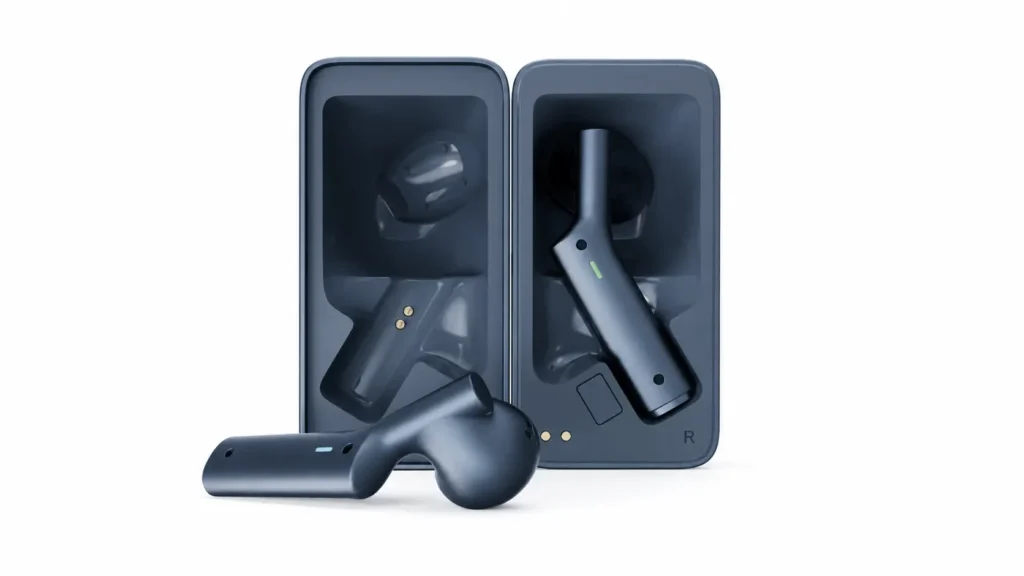
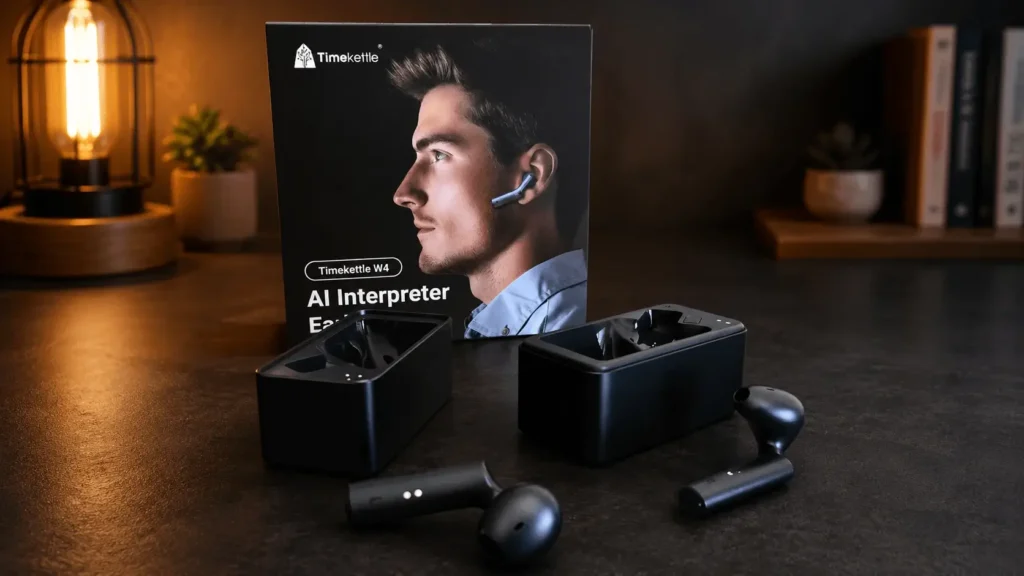
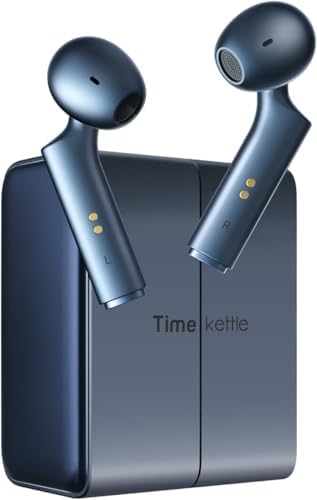
The W4 ships in Midnight Blue or Sandy Gold, packaged in a way that feels closer to premium consumer electronics than to a niche gadget. Instead of a round charging case, Timekettle uses a square, matte-finished case that splits into two magnetic halves, each holding one earbud. That detail matters more than it sounds: it means you hand your conversation partner a sealed half-case rather than a used earbud straight from your ear, which is a small but appreciated hygiene consideration noted across independent reviews.
Build quality is generally described as solid, with no creaking or flex in the case, though the case itself runs larger than a typical earbud case because the earbuds use an unusually long stem to bring the microphones closer to the mouth. Some testers found the case a little bulky to carry alongside a phone and wallet in a single pocket.
Design and Comfort. Can You Wear Them All Day?
This is where reviewer opinions genuinely diverge, and it’s worth covering both sides honestly in this Timekettle W4 Review.
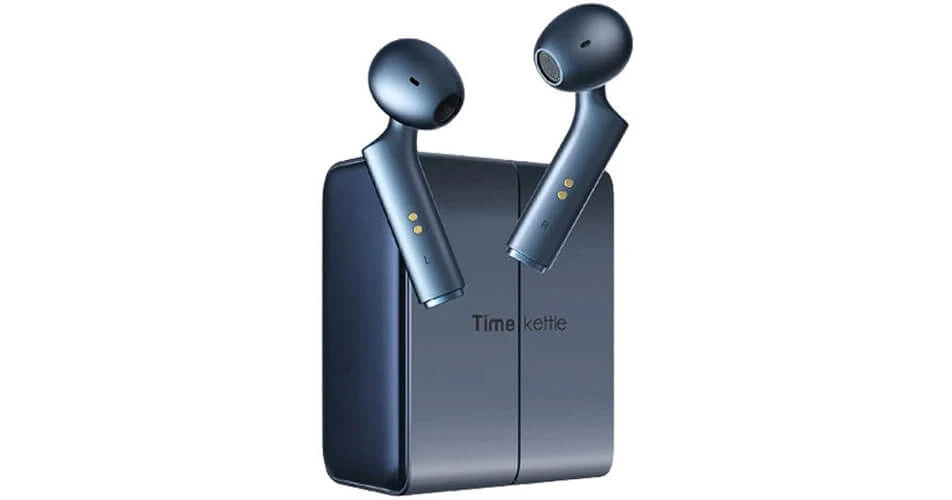
The earbuds use a semi-in-ear, open-ear, bone-conduction design rather than sealed ear tips. That keeps your ear canal open so you stay aware of your surroundings, which is useful for walking through unfamiliar cities or staying alert in transit hubs. Timekettle also includes clip-on ear hooks in the box to improve stability.
On the positive side, testers who used the clips reported a noticeably more secure, all-day-wearable fit, describing the earbuds as lightweight enough to forget about after extended use. On the more critical side, at least one hands-on reviewer found that without the clips, the long stem design combined with reduced grip meant the earbuds could slip out fairly easily, requiring frequent readjustment. The takeaway: use the included clips, especially if you plan to wear the W4 for hours at a time or during active movement.
The Technology Behind the Translation
Bone Voice Print and Voice Isolation
Each earbud contains a sensor that reads vibrations transmitted through your jawbone and ear cavity as you speak. Because this signal travels through bone rather than air, the system can isolate your voice from ambient noise more effectively than a standard microphone alone, at least in theory. Timekettle’s marketing cites accuracy figures around 98% and describes resistance to noise levels up to 100dB, positioning the W4 for use in airports, trade shows, and crowded restaurants.
Independent testing offers a more measured picture. Reviewers who tested the W4 in genuinely loud, layered environments, such as a busy street market or an airport gate, found that voice isolation worked reasonably well when the main speaker stayed close to the phone and background noise remained more distant than the primary conversation, but performance degraded once multiple nearby voices competed at a similar volume.
In other words, the bone-conduction advantage is real, but the “works in any 100dB environment” claim should be treated as a best-case scenario rather than a guarantee.
Babel OS 2.0 and Context-Aware Translation
Rather than translating word by word, Timekettle’s Babel OS software is designed to process full sentences or thoughts before generating a translation, aiming to preserve tone, register, and intent rather than producing a stilted, literal rendering. Timekettle says the system integrates large language models on the back end to handle recognition and correction, with translation delivered in roughly half a second in ideal conditions.
In practice, several reviewers found this context-awareness to be inconsistent. One hands-on test noted that the AI sometimes failed to track context across a single conversation, at one point correctly identifying a niche sporting term and then mistranslating the same term moments later.
Formality and pronoun handling (for example, switching between formal and informal address mid-conversation) was also flagged as an issue in one detailed test. This suggests that while the underlying idea of semantic, context-aware translation is sound, the execution doesn’t yet fully deliver a natural, error-free conversation every time.
The App Experience
The Timekettle companion app, available on iOS and Android, handles pairing, language selection, and mode switching, and most reviewers describe first-time setup as fast, typically well under five minutes from opening the box to a working translation.
Inside the app, you choose an input and output language independently for each side of the conversation. Timekettle advertises broad coverage, with marketing material citing figures ranging from roughly 40 to 52 supported languages and dozens of regional accents, depending on the source and firmware version. Offline, without any internet connection, the number of usable language pairs drops sharply, commonly cited around 13 pairs, and those packs must be downloaded in advance.
Three main modes appear across the app: one-on-one dialogue, where both people wear an earbud for a natural back-and-forth conversation; a listen-and-translate mode for following a lecture, meeting, or announcement; and media translation, which attempts to translate audio playing from other apps on the same phone, such as a video or a call. The app also includes AI-generated meeting summaries, a language-learning speaking tutor, text translation, and a saved vocabulary list.
One detail worth flagging for privacy-conscious buyers: Timekettle’s system relies primarily on cloud processing for the strongest accuracy, meaning voice data is transmitted for translation rather than staying fully on-device. The company positions its ecosystem as privacy-focused and provides a privacy policy outlining how data is handled, but this is not marketed as a fully offline, zero-data-transmission system, and it should not be relied on for confidential business, legal, or medical conversations.
Real-World Translation Accuracy
This is the part of any Timekettle W4 Review that matters most, because no one buys translation earbuds for the case design. Accuracy is not a single number; it shifts significantly depending on language pair, background noise, mode selection, and how closely both speakers follow best practices (staying near the phone, speaking clearly, pausing between complete thoughts).
Quiet, one-on-one conversations produced the strongest results across nearly every test. Reviewers testing English paired with French, German, or Japanese in calm settings generally described the experience as impressively close to a real conversation, with simple exchanges, small talk, and practical requests like ordering food translating cleanly.
Less common or more distant language pairs showed more inconsistency. In one detailed household test, English-Romanian translations were noticeably less smooth than English-French, and in another, a Telugu-English conversation produced correctly-toned meaning but also multiple misheard words and awkward phrasing, with one reviewer’s spouse describing the translated voice as overly formal and robotic-sounding.
Noisy environments are where results become genuinely mixed. In a street-market scenario, one tester found that the system confused “kilo” with “pillow” and struggled with vegetable names in fast mode, while a switch to a more accurate mode fixed some errors but introduced others.
In an airport-style test, distant background noise was handled reasonably well as long as the main speaker stayed close and clear, but the marketing claim of reliable performance in a full 100dB environment was described by multiple reviewers as promising rather than fully proven.
Business and formal settings are where reviewers were most cautious. One tester who ran the device through a bilingual conversation involving pauses mid-sentence found that the AI would sometimes insert an inappropriate sentence ending, then start a fresh sentence when the speaker continued, occasionally distorting meaning.
Similar-sounding words were sometimes confused in ways that changed the meaning of what was said. The consistent recommendation across nearly every independent review: treat the W4 as a support tool for low-stakes conversations, not a replacement for a professional interpreter in negotiations, legal discussions, or anything where exact wording carries consequences.
Does the Timekettle W4 Work Offline?
Yes, but with real limitations. Offline mode requires downloading specific language packs in advance through the app, and only a subset of the full language list (commonly cited around 13 pairs) is available without an internet connection.
Multiple reviewers independently found that offline translation felt noticeably slower and less fluid than online translation, with one describing offline results while moving around a room as fragmented enough that the conversation became hard to follow.
The practical takeaway is that offline mode functions best as a safety net for basic, essential communication in a signal-dead area, rather than as a mode you’d choose by preference. If your travel plans depend heavily on a specific offline language pair, verify availability in the app before you buy, since coverage is narrower than the headline online language count suggests.
Battery Life
Timekettle’s stated figures put the W4 at roughly 3.5 to 4 hours of continuous translation and around 6 to 7 hours of music playback on a single earbud charge, extending to approximately 10 hours of translation and 18 hours of music with the charging case factored in.
Reviewers who tracked real-world use during a full afternoon of intermittent translation generally found these figures realistic for typical travel patterns, where the earbuds are used in short bursts rather than continuously for hours at a stretch. If you expect to run back-to-back translation sessions all day, plan to keep the charging case within reach.
Sound Quality for Everyday Listening
Because the W4 doubles as a regular pair of Bluetooth earbuds, sound quality for music matters to some buyers. Independent testing was consistently unenthusiastic on this point: bass is under-represented, treble and mids lack differentiation, and the overall sound was described as thin and not well suited to casual music listening.
If you’re hoping the W4 will replace a dedicated pair of everyday earbuds, temper those expectations; this hardware was engineered around clear speech capture, not audio fidelity.
Timekettle W4 vs. the Rest of the Lineup
| Model | Approx. price | Translation battery | Best for |
| Timekettle M3 | $149 | Up to ~7.5h | Casual, occasional use, budget-conscious buyers |
| Timekettle W4 | $349 | ~3.5-4h | Everyday two-way conversation: travel, family, casual business |
| Timekettle W4 Pro | $449 | Up to ~6h | Formal business settings, negotiations, longer sessions |
The W4 sits in the middle of Timekettle’s range. Compared with the entry-level M3, it offers a more current design and generally stronger positioning around AI features, at a real price jump. Compared with the W4 Pro, the standard W4 trades some battery life and business-oriented polish for a lower price and a more casual, everyday-earbud look and feel.
If your use case is mostly personal travel, family conversations, or casual meetups, the W4 is the more sensible buy over the Pro; if you’re doing repeated formal business interpreting, the extra battery life and business-first design of the Pro may be worth the additional cost.
It’s also worth knowing that Timekettle’s own AI features on the Pro model have, in at least one independent test, come with ongoing costs beyond the initial purchase price, including paid credit for extra translation minutes and paid offline language packs after an initial free allotment. Buyers considering any model in this lineup should check the current in-app pricing structure before assuming the upfront cost is the only cost.
Who Is the Timekettle W4 Actually For?
Based on the combined pattern across hands-on tests, the Timekettle W4 makes the most sense for:
- Frequent travelers heading to destinations where they don’t speak the local language and want smoother, more natural exchanges than a phone app allows for repeated conversations.
- Multilingual families and couples, where the device can act as a bridge during visits, gatherings, or daily life between relatives who don’t share a first language.
- Language learners who want extra exposure and confidence, using the built-in AI speaking tutor and contextual translation as a supplement to active study, not a replacement for it.
- Casual business travelers handling low-stakes interactions such as hospitality, simple client conversations, or reception-desk communication, where an occasional imperfect translation isn’t costly.
It’s a weaker fit for anyone expecting flawless, subtitle-quality accuracy, for high-stakes professional negotiations where exact wording has legal or financial consequences, and for buyers who only need a translation tool for the occasional one-off question, since a free phone app may cover that need at no cost.
Timekettle W4 Review: Frequently Asked Questions
Is the Timekettle W4 accurate enough to trust for real conversations?
It’s accurate enough for everyday, low-stakes conversation, especially in quiet settings with common language pairs like English and French, but multiple independent tests found real errors in noisy environments, business contexts, and less common language pairs. Treat it as a communication aid, not a substitute for fluency or a professional interpreter.
Does the Timekettle W4 work without an internet connection?
Yes, but offline mode supports far fewer language pairs (commonly around 13) than online mode, and reviewers consistently found offline translation noticeably slower. Download your needed language packs in the app before you lose signal.
How is the Timekettle W4 different from the W4 Pro?
The W4 Pro is positioned for business use, with a longer battery life (up to roughly 6 hours of translation versus about 3.5 to 4 hours on the W4) and a more formal design. The standard W4 is the more casual, everyday-travel-oriented option at a lower price.
How long does the battery last?
Roughly 3.5 to 4 hours of continuous translation per earbud charge, or about 10 hours total when paired with the charging case, according to Timekettle’s own figures, which held up reasonably well in real-world testing focused on intermittent, travel-style use.
Is the Timekettle W4 worth $349?
For frequent travelers, multilingual families, and language learners who will use it repeatedly, most reviewers conclude it’s a worthwhile, if imperfect, investment. For occasional tourists who only need the occasional translated phrase, a free smartphone translation app may cover the same need without the cost.
Final Thoughts
This Timekettle W4 Review set out to combine marketing claims with the messier reality of real conversations, and the honest conclusion sits in between the two. The W4 genuinely improves on the awkwardness of holding a phone between two people, and in calm, favourable conditions it delivers translation that feels close to a real conversation.
But it is not the flawless, instantaneous sci-fi translator suggested by polished demo videos. Accuracy softens in noise, with less common languages, and in fast-moving group settings, and the price puts it firmly in considered-purchase territory rather than impulse-buy territory.
If you travel often, live in or visit a multilingual household, or want a genuine step up from typing into a translation app, the Timekettle W4 is worth serious consideration. If you need guaranteed precision for business-critical conversations, plan to lean on a human interpreter and treat the W4 as useful backup rather than your primary tool.
Read More; Bose 700 Wireless Noise-Cancelling Headphones Review