If you’ve been circling the entry-level planar magnetic headphone market, you’ve probably landed on the same name over and over: the Hifiman HE400i. It’s one of the few headphones that regularly gets recommended by people who’ve owned gear costing ten times as much, and that reputation isn’t an accident.
In this review I’m going to go deeper than a spec sheet and a two-paragraph verdict, I’ll walk through the history behind the HE400i, what’s actually changed between versions, how it’s built, how it sounds across the frequency range, what you need to power it properly, and how it stacks up against its closest rivals so you can decide if it deserves a spot on your head.
A Quick History: Why the HE400i Costs So Little
To understand today’s Hifiman HE400i, it helps to know where it came from. The original HE-400 launched back in 2012 as a darker-sounding orthodynamic (planar magnetic) headphone that introduced a lot of listeners to the format for the first time.
In 2015, Hifiman released the HE400i, a refined version that sold for around $499 and quickly became one of the brand’s best-selling models thanks to its clarity, speed, and black background, traits that were rare at that price point back then.
Then, in 2020, Hifiman did something unusual: instead of discontinuing the design or replacing it with something pricier, they re-released the HE400i using the exact same driver as the 2015 model, but wrapped it in a new headband, new earpads, a lighter frame, and simplified 3.5mm cable connectors instead of the old screw-on SMC terminations. The price dropped from $499 to just $169.
The reasoning is fairly simple from a business standpoint, headphones in the $150–$250 range consistently sell in far larger volumes than anything above $500, and Hifiman clearly wanted a planar magnetic product that could compete directly in that bracket.
For consumers, though, the result is one of the best value propositions in the hobby: a genuine desktop-class planar driver, the same one used in a headphone that used to sell for triple the price, now available for less than most decent dynamic-driver headphones.
Unboxing and What’s in the Box
The HE400i 2020 ships in a double-box setup for shipping protection, with the headphone itself sitting in a foam cutout wrapped in a silky, velvet-like fabric. Inside you’ll find:
- The HE400i headphones
- A detachable 1.5m cable terminated in a 3.5mm (1/8″) plug
- A 6.35mm (1/4″) adapter for desktop amps
- An owner’s guide and warranty card
There’s no hard carrying case, which is a fair criticism at this price, but the packaging itself feels a step above what you’d expect from a $169 product, Hifiman reportedly reuses the same box design from its pricier Arya and Deva models.
Build Quality, Design, and Comfort
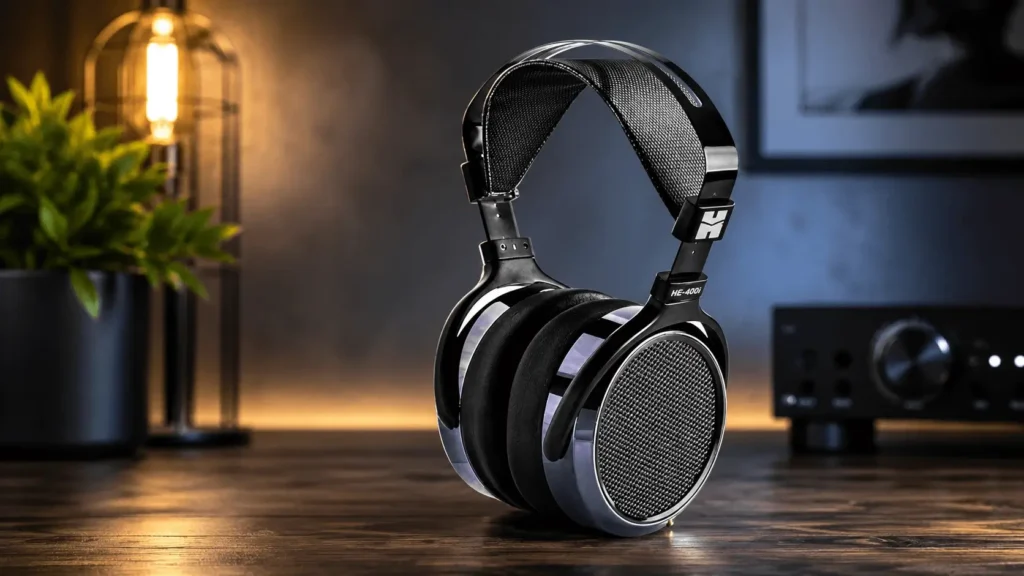
This is where the Hifiman HE400i genuinely surprises people who assume “budget” means “flimsy.” The headband, yokes, and height-adjustment rods are metal rather than plastic, and only the earcups themselves are made from ABS polymer/hard plastic.
The look borrows heavily from older, well-regarded Hifiman designs like the HE-500 and HE-6, giving it a more premium, understated aesthetic than most headphones in its price class.
Weighing in at roughly 370 grams, it’s notably light for a planar magnetic headphone, most orthodynamic designs use heavier magnet arrays that add weight, but the HE400i’s single-sided magnet array keeps things comfortable for long sessions.
The earpads are deep, soft, and use a mix of pleather and breathable material that avoids heat buildup, and they sit further from your ears than on Hifiman’s Sundara, meaning even people with larger ears typically won’t feel their skin touching the driver grille.
A couple of minor gripes worth knowing about before you buy:
- The earcups swivel only a small amount (roughly 15 degrees), which can matter if you have an unusually shaped head.
- There’s no carrying case included.
- The nylon jacket around the cable connectors can start to show wear after a year or so of regular use, though the cable itself is user-replaceable.
Technical Specifications
| Spec | Detail |
| Driver type | Planar magnetic (single-sided magnet array) |
| Frequency response | 20Hz – 35kHz |
| Impedance | 35 Ω |
| Sensitivity | 93 dB/1mW |
| Weight | ~370g |
| Cable | 1.5m detachable, 3.5mm termination + 6.35mm adapter |
| Open/closed | Fully open-back |
| Price | ~$169 USD |
On paper, the numbers suggest the HE400i should be easy to drive from a phone or laptop. In practice, that’s only partly true, which brings us to one of the most important sections of this review.
Sound Signature
The HE400i has a signature that’s instantly recognizable as a Hifiman product: technical, airy, fast, and slightly lean rather than warm or lush. It won’t be everyone’s cup of tea, but for the price, its strengths are genuinely hard to find elsewhere.
Bass
The bass is textured, fast, and controlled rather than boomy. Mid-bass is arguably the standout part of the frequency response, punchy, well-defined, and requiring no EQ to sound right. Sub-bass, on the other hand, rolls off gently below roughly 60Hz, so if you’re a basshead chasing rumble and physical slam, this isn’t naturally your headphone out of the box.
The good news is that the roll-off is linear and predictable, so a modest EQ boost in the 20–60Hz range brings the low end much closer to what you’d hear from Hifiman’s pricier models like the Arya.
Midrange
This is the most polarizing part of the HE400i’s sound. It’s neither warm and syrupy like an Audeze planar nor thick and vocal-forward like a Sennheiser HD6XX. Instead, it’s linear, clean, and a touch reserved, some listeners describe it as slightly recessed compared to the bass and treble around it. Paired with a warmer-sounding amplifier or DAC, the midrange fills out noticeably, so the headphone is more source-dependent in this region than you might expect from something in this price bracket.
Treble
Treble is where the HE400i really shows off its planar magnetic pedigree. It’s detailed, extended, and full of texture on cymbals, strings, and percussion, with a gentle dip in the 3–6kHz range followed by a rise around 7–10kHz that gives it an airy, resolving character. It can lean slightly bright or even a little hot on already-bright recordings, but on a well-matched, warmer chain it settles into something genuinely impressive for the price.
Soundstage, Imaging, and Detail Retrieval
This is the category where the HE400i earns most of its praise. As a fully open-back design with no foam or felt layers between the driver and the outer grille, it produces a wide, naturally spread soundstage with excellent layering and pinpoint imaging, qualities usually associated with headphones costing several times as much.
Detail retrieval is similarly strong; fine, low-level details in a mix come through with a clarity that a lot of closed-back and even some pricier open dynamic headphones struggle to match.
Amplification: Does the Hifiman HE400i Really Need an Amp?
Here’s the part that trips a lot of buyers up. With a sensitivity of 93dB/1mW and impedance of 35Ω, the HE400i looks easy to drive on paper. In real-world use, though, Hifiman’s planar headphones, including the HE400i, Sundara, and Arya, tend to need noticeably more current than the numbers suggest to sound their best.
Straight out of a phone or a laptop headphone jack, the HE400i will play, but at reduced dynamics, a thinner-sounding bass, and less separation than it’s capable of. Feed it from a dedicated DAC/amp, even a modestly priced desktop stack in the $150–$300 range, and the difference is substantial: tighter bass, better control, a wider stage, and a more three-dimensional presentation overall.
Practical takeaway: budget for a basic external DAC/amp if you’re serious about hearing what this headphone can do. You don’t need anything exotic, a well-reviewed budget stack is enough to unlock most of its potential, but plugging it straight into a phone will genuinely undersell it.
How the Hifiman HE400i Compares to Its Rivals
HE400i vs. Hifiman Sundara
The Sundara generally has a more neutral, evenly balanced tuning with better sub-bass extension and a slightly more forgiving midrange, while the HE400i counters with a leaner, more analytical presentation and a marginally wider stage. If you want a more “reference” sound, Sundara edges ahead; if you like a faster, airier presentation, the HE400i holds its own for less money.
HE400i vs. Hifiman Deva (wired)
These two share nearly identical build, weight, and comfort. The Deva tends to have a stronger, more linear sub-bass and a slightly warmer overall tone, making it feel calmer and more mainstream-friendly. The HE400i counters with cleaner, less distorted treble and a slightly more resolving, “audiophile” character. Neither is strictly better, they simply target different preferences.
HE400i vs. Hifiman HE4XX
The HE4XX (a Drop collaboration based on older HE-400i tuning with the classic earpads) tends to sound warmer and thicker in the midrange, while the 2020 HE400i is more technical, airier, and better resolved in the treble. If you want vocals with more body, HE4XX may appeal more; if you value detail and stage, the newer HE400i is the stronger technical performer.
HE400i vs. the original 2015 HE400i
Since both use the same driver, the tonal character is close, but the 2020 version benefits from a lighter, more comfortable headband, deeper and plusher earpads, and a far more practical 3.5mm cable connector instead of the older screw-on SMC terminals, all at a third of the original launch price.
Who Should Buy the Hifiman HE400i?
The Hifiman HE400i is best suited to:
- First-time planar magnetic buyers who want to understand what the format offers without a big financial commitment
- Listeners of rock, metal, electronic, and other fast, detail-dense genres who value speed and separation over bass weight
- Anyone who already owns (or is planning to buy) a basic desktop DAC/amp
- Detail-and-soundstage-focused listeners who don’t mind a slightly lean tonal balance
It’s a less natural fit if you’re a committed basshead looking for slam straight out of a phone, or if you specifically want a warm, vocal-forward sound signature without EQ.
Frequently Asked Questions
Is the Hifiman HE400i good for gaming?
Yes, its wide, open soundstage and precise imaging make it genuinely useful for positional audio in competitive games, though the open-back design means no isolation, so it’s better suited to quiet home environments.
Does the Hifiman HE400i need a separate DAC and amp, or just an amp?
An amp is the priority. Most modern computers and phones already have a DAC section that’s more than sufficient; what the HE400i actually needs is more clean current than a typical headphone jack delivers.
Can I use the Hifiman HE400i with a phone?
You can, and it will play music, but expect thinner bass and less dynamic impact than it’s capable of. A dongle DAC/amp with reasonable power output makes a meaningful difference.
Is the Hifiman HE400i better than the Sundara?
Neither is definitively “better”, the Sundara leans more neutral and bass-extended, while the HE400i leans faster and airier. Preference comes down to tonal balance more than outright quality.
Final Verdict
Few headphones under $200 manage to combine a genuine planar magnetic driver, solid metal-and-leather construction, and a resolving, spacious sound signature the way the Hifiman HE400i does. It isn’t tonally perfect, the sub-bass needs a light EQ touch and the midrange won’t satisfy listeners chasing warmth, but as an entry point into planar magnetic sound, it remains one of the strongest value picks in the entire headphone market.
Pair it with even a modest external amp, and it’s genuinely hard to find another headphone at this price that competes with it on detail, soundstage, and overall technical performance.
Read More: Sony WH-CH520 Headphones Review