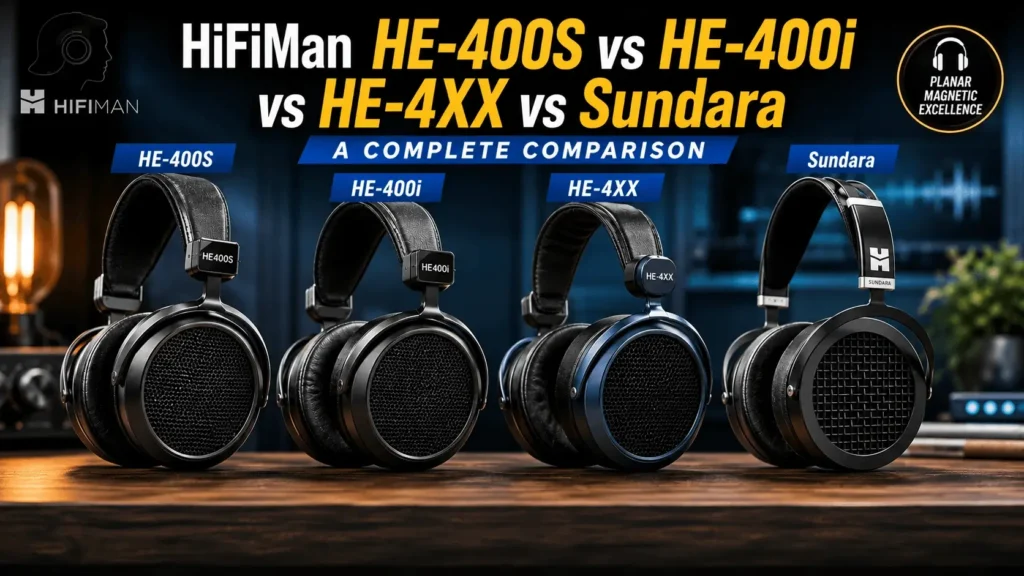
Choosing between HiFiMan’s budget-to-midrange planar magnetic headphones can be confusing, since the HE-400S, HE-400i, HE-4XX, and Sundara all share a family resemblance in both design and sound. Having lived with all four models, the HE-400S and HE-4XX on hand for direct testing, the HE-400i sourced from a friend, and the Sundara demoed extensively in the past, this article breaks down how they actually compare on build quality, comfort, sound signature, and value, to help you decide which one deserves a spot in your collection.
Worth noting upfront: the HE-400i was dropped from several retailers’ lineups, largely due to quality-control issues that worsened over successive production runs. That history colours several of the comparisons below.
Build Quality and Weight
Weight is one of the more surprising differentiators in this lineup:
- HE-400S: The lightest of the four, weighing in around 350 to 360 grams.
- HE-400i: Roughly 370 grams.
- Sundara: Also around 370 grams (some sources list it as high as 379 grams).
- HE-4XX: The heaviest by a notable margin at approximately 406 grams, despite being marketed at the same weight as the HE-400i. Adding the Dekoni pads (discussed below) tacks on another 11 grams.
Despite its higher spec weight, the HE-4XX doesn’t feel as heavy on the head as the number suggests, it’s noticeably lighter in wear than something like the HiFiMan Ananda, even though it’s heavier than its 400-series siblings.
Cabling
Cabling is one of the more consequential differences between these models. The HE-400S can occasionally suffer from intermittent sound cutouts, a known quality-control issue that also plagued the HE-400i, especially in later production runs. A workaround is to unplug and reseat the 3.5mm connectors at each ear cup, which often (but not always) resolves the issue.
The HE-4XX and Sundara, by contrast, use a more traditional cable design and don’t share this cutout problem, making them the more dependable choices if cable reliability is a priority. All four headphones use an L-shaped 3.5mm plug at the source end that splits into a Y-cable, with 3.5mm terminations at each ear cup and included quarter-inch adapters. The HE-400S and HE-400i use a braided cable, while the HE-4XX and Sundara use a smoother, traditional round cable.
Headband and Adjustment
- HE-400i and HE-400S: Use a square adjustment piece to move the headband’s overhead padding up and down. The overall headband shape is unusual, described as resembling a “deformed ostrich”, but functions reliably.
- HE-4XX: Uses a circular, thicker adjustment mechanism combined with a mix of spring steel, plastic, and faux leather stitching in a midnight blue finish. It looks fine, but the material choices feel slightly mismatched in hand. Some units may have an adjustment slider that doesn’t move smoothly on one side, this appears to be inconsistent between units rather than a universal flaw, so the HE-4XX is still considered one of the safer builds to buy today, especially relative to the increasingly troubled HE-400i.
- Sundara: Has the most refined headband shape of the group, more rounded and better integrated, and overall feels like the most solid, robust build of the four. Its grille design also stands out: while the HE-400i, HE-400S, and HE-4XX all share a honeycomb grille pattern, the Sundara uses a lattice design that contributes to its more premium feel.
Ear Cups and Swivel
The HE-400i and HE-400S ear cups rotate a full 90 degrees, similar to something like the ATH-M50x, allowing them to lie flat. The HE-4XX swivels about 45 degrees, and the Sundara doesn’t swivel at all. This is more of a design preference than a functional dealbreaker for most listeners.
Stock Pads
The stock pads on the HE-400i, HE-400S, and Sundara are a weak point across the board. HiFiMan wraps a thin sliver of faux leather around the cup and glues it on, which tends to peel over time, especially if pads are swapped frequently. For anyone planning to keep pads long-term without much swapping, the stock pads should hold up reasonably well; frequent swappers should budget for replacements.
The recommended upgrade is the Dekoni sheepskin leather pads, which use a full wraparound piece of leather that drapes over the cup without requiring glue. It’s a noticeably better design, even if it’s a bit surprising that a third-party company solved a problem HiFiMan’s own stock pads never addressed.
Comfort
All four headphones are comfortable overall, but with some distinctions:
- HE-400S: The comfort standout of the group. It’s light enough that it rarely needs adjustment during long listening sessions, comparable to the familiar, well-worn feel of a Sennheiser HD 600.
- HE-400i and Sundara: Share similar ear cups and padding to the HE-400S, and offer comparable comfort.
- HE-4XX: Slightly less comfortable than the others due to its headband, which can dig in during extended sessions. It’s still good overall, just requiring more occasional readjustment than the rest.
Clamp force across the line is moderate, noticeably less aggressive than an HD 600 fresh out of the box, and none of the four should require major fit corrections during normal listening.
Sound Signature
All four headphones share the smoother, more textured low-end extension characteristic of planar magnetic drivers compared to dynamic drivers, along with a refined and realistic bass response.
Bass: Roughly similar between the HE-400i, Sundara, and HE-4XX, all offering deep, well-extended low end without bleeding into other frequencies. The HE-400S has the most noticeably rolled-off bass of the group, which in isolation still sounds fine but comes across as slightly less full, and by direct comparison, a touch grainier, than the HE-400i.
Treble: This is where the differences are most pronounced.
- The Sundara has the most relaxed, laid-back treble of the four.
- The HE-400S is the next most relaxed.
- The HE-400i follows.
- The HE-4XX has a noticeable peak around 10kHz that introduces a metallic, spiky character to the upper frequencies, arguably its biggest sonic drawback. It can be tamed somewhat with EQ, but out of the box it’s the most fatiguing of the four in the treble region.
Warmth: The HE-400i tends to sound the warmest of the group, with the Sundara landing as something of a middle ground between the HE-400i and HE-400S.
Soundstage and Imaging: All four headphones handle spatial presentation well, though the HiFiMan HE-400 series in general sits a tier below flagship-class options like the AKG K702 in terms of width and depth. Where the 400-series headphones (and planar designs generally) shine is in timbre and instrument texture, vocals and instruments render with more nuance and a more three-dimensional, “in the room” quality than comparable dynamic-driver headphones, even against otherwise higher-performing headphones in raw soundstage terms.
Amplification
All four headphones benefit from amplification, though none are especially demanding:
| Model | Impedance | Sensitivity |
| HE-400S | 22 ohms | 98 dB |
| HE-400i | 35 ohms | 93 dB |
| HE-4XX | 35 ohms | 93 dB |
| Sundara | 37 ohms | 94 dB |
The HE-400S is the easiest to drive of the four, while the Sundara is the most demanding, though the difference across the lineup is modest. A budget-friendly USB DAC/amp like an AudioQuest DragonFly Red pairs well with all four and offers a versatile “start small, upgrade later” path, since its line-out can feed into any downstream amp that accepts a line-level input.
Genre Performance
These headphones perform well across a wide range of genres: hip-hop, indie, pop, rock, metal, classical, jazz, downtempo, folk, acoustic, and ambient all sound solid. They’re particularly well suited to quieter, more acoustic material, similar to how a headphone like the K702 handles those genres, though the K702 still edges out the 400 series specifically on complex jazz passages, where nuanced imaging matters most.
Bass response across the lineup is a strong suit for listeners who enjoy deep, textured low end without distortion or bloat, a good option for anyone moving up from a more bass-forward closed-back headphone looking to hear what accurate, well-extended bass actually sounds like.
Final Recommendation
There’s no single “best” answer here, each headphone makes a real trade-off:
- Sundara: The top overall pick. It has the most solid build, the smoothest and most balanced sound signature, and no treble peak or cabling reliability concerns. Some listeners may find it a touch too relaxed or warm, but that’s a matter of preference rather than a flaw.
- HE-4XX: A strong second choice, primarily because it avoids the cabling issues that affect the HE-400S. At around $130, it’s an exceptional value and a great entry point into planar magnetic sound. Just be aware of its treble peak and slightly less comfortable headband over long sessions.
- HE-400S: Excellent comfort and sound, but the cutout issue with its cabling is a real and recurring drawback that keeps it from being an easy top recommendation.
- HE-400i: Historically excellent, particularly in its original production run, but newer batches have suffered from significant quality-control problems. It’s no longer widely recommended as a fresh purchase, and several retailers have discontinued carrying it for that reason.
For anyone dipping a toe into planar magnetic headphones for the first time, the HE-4XX at roughly $130 remains one of the best entry points available. For those willing to spend a bit more for a more polished, worry-free experience, the Sundara is the more complete package.
Read More: The 5 Best 6.5-Inch Marine Speakers for Boats, Jet Skis